LACMA's New Building: A Transformative Vision
There is a building on Wilshire Boulevard that has been under construction for four years and in planning for nearly two decades, and in five weeks it will finally open its doors. When it does, the Los Angeles County Museum of Art will become a different kind of institution than the one that has occupied this stretch of Hancock Park since 1965. It will also become one of the most architecturally significant museum buildings in the world.
The Los Angeles County Museum of Art announced that the David Geffen Galleries will open on April 19 with a ribbon-cutting celebration, marking the beginning of two weeks of priority member access to the galleries as well as a series of events.
The full public opening begins May 4, 2026, with ongoing programming, events, and activations throughout the spring and summer.
This is not a new wing or an expanded gallery block. It is a singular, purpose-built structure designed by one of the most demanding architects alive, containing more exhibition space than the entire LACMA campus held just 19 years ago, organized around a curatorial philosophy that has never been attempted at this scale anywhere in the world. For Angelenos who have watched the construction crane silhouettes from the 10 freeway and the Miracle Mile sidewalks for years, the wait is almost over. Here is everything you need to know before you go.
The Building: A 900-Foot Architectural Marvel
The architecture is the first story and deserves its own careful explanation, because the David Geffen Galleries are not simply a container for art. The building is itself an argument about what a museum should be.
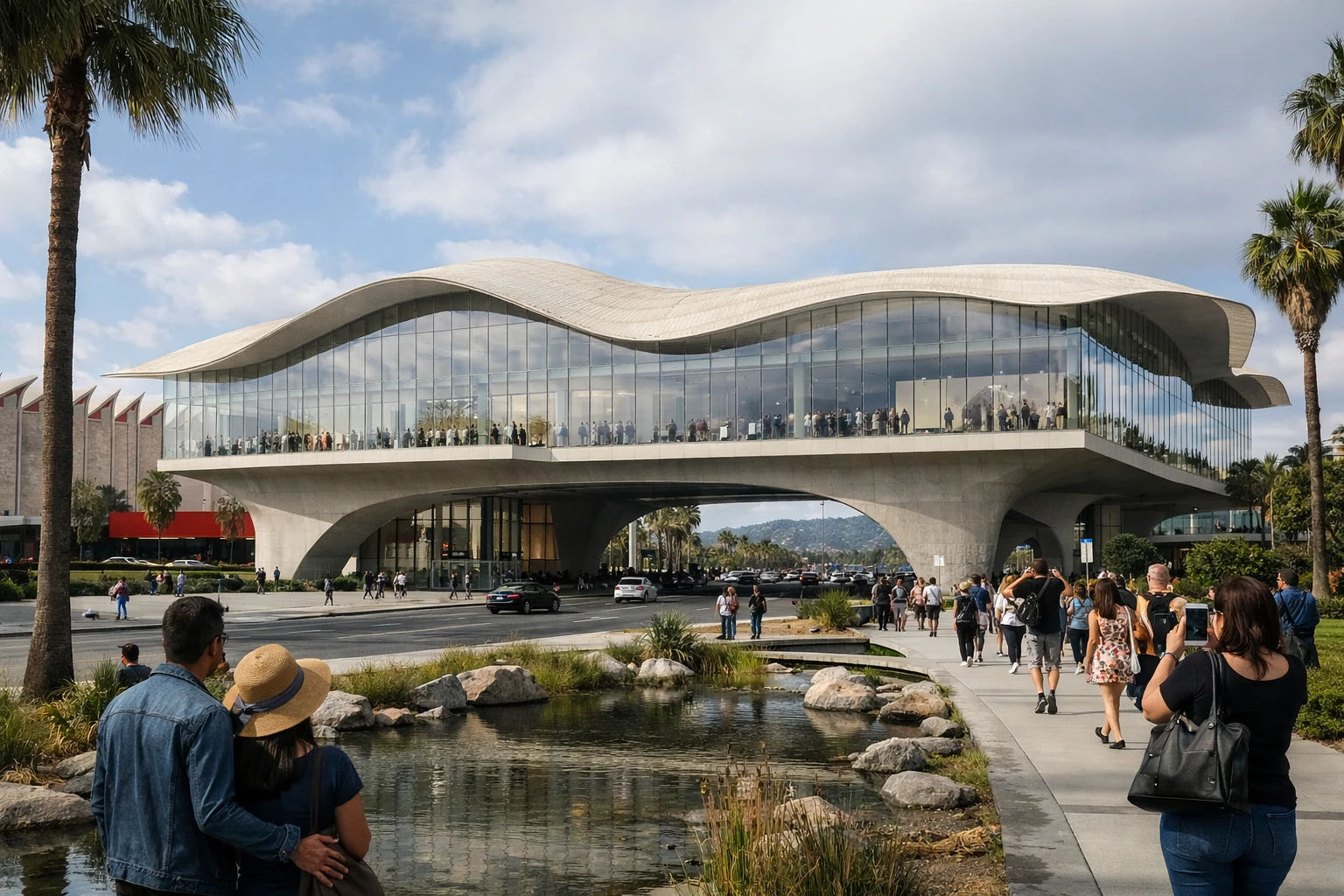
Designed by Swiss architect Peter Zumthor, the building is the new home for LACMA's permanent collection. Spanning Wilshire Boulevard, the elevated 900-foot-long exhibition space enables art from all cultures and eras to be presented on a single level without hierarchies or prescribed visitor pathways.
Peter Zumthor is one of the most celebrated and least prolific architects working today. He received the Pritzker Prize, architecture's highest honor, in 2009, and is known for buildings that achieve a quality of atmosphere and material honesty that most architectural practices never reach. His previous work includes the Therme Vals spa in Switzerland, the Bruder Klaus Field Chapel in Germany, and the Kolumba Art Museum in Cologne. The LACMA commission is the largest project of his career.
Designed by Pritzker Prize-winning Swiss architect Peter Zumthor in collaboration with Skidmore, Owings & Merrill, the elevated 900-foot-long concrete-and-glass structure spans Wilshire Boulevard and becomes LACMA's new primary home for its permanent collection.
The form of the building, which has been described variously as amoeba-shaped, sinuous, and cloud-like from aerial views, resolves at street level into something that feels more elemental: a long, continuous horizontal volume floating above the boulevard, resting on a series of ground-floor pavilions that open the underside of the building to the street. Wilshire Boulevard passes directly underneath the exhibition floor. You can walk from Hancock Park on the north side to the tar pits on the south side without leaving the museum's footprint.
The design of the David Geffen Galleries seamlessly integrates the building with Hancock Park and opens 3.5 acres of new outdoor space, which will be activated with public art installations, educational programming, and events. That outdoor space, on both sides of Wilshire, transforms the relationship between the museum and its immediate neighborhood in ways that have implications for how the surrounding Miracle Mile, Hancock Park, and Mid-Wilshire communities experience the institution every day, not just on days when they come to see art.
"The David Geffen Galleries are not simply a container for art. The building is itself an argument about what a museum should be."
Staggering Numbers: A New Era for LACMA
The scale of the David Geffen Galleries relative to what LACMA has had before deserves to be stated clearly, because the numbers are genuinely staggering.
With the 110,000 square feet of exhibition space in the David Geffen Galleries, LACMA will have 220,000 square feet of galleries total, a significant increase from its 130,000 square feet in 2007. That is almost exactly double the space the museum had two decades ago, in a single building addition. And it comes after the museum already expanded significantly with the addition of the Broad Contemporary Art Museum in 2008 and the Lynda and Stewart Resnick Exhibition Pavilion in 2010.
The building is designed to hold approximately 2,500 to 3,000 objects from the museum's global collection at one time. LACMA's permanent collection contains over 150,000 works. The Geffen Galleries will show roughly two percent of that collection at any given moment, which means the question of what is on view and what is in storage becomes an active, ongoing curatorial conversation for years to come.
The Building LACMA campaign has raised $793 million to date, exceeding its initial $750 million fundraising goal, inclusive of the building cost of $715 million, including contingency added for tar and fossil impacts. That last parenthetical refers to one of the more unusual engineering challenges of the project: the building sits adjacent to the La Brea Tar Pits, and the active tar seeps beneath the ground required specific structural responses during construction. In a very literal sense, this museum is built above one of the most significant fossil records in North America.
"The numbers are genuinely staggering."
Inaugural Exhibition: Art Across Oceans
The curatorial concept behind the inaugural installation of the David Geffen Galleries is one of the most genuinely experimental ideas a major art museum has attempted in recent memory, and it is worth understanding before you walk through the doors.
Rather than displaying artworks according to medium or period, the inaugural installation will use the Pacific, Indian, and Atlantic Oceans and the Mediterranean Sea as its organizing framework, emphasizing the cultural exchange, migration, and commerce prevalent throughout the history of art.
This is a radical departure from the standard encyclopedic museum model, which organizes collections chronologically and geographically, placing Greek antiquities in one wing, European painting in another, and Asian art in a third. That model, which most major Western museums still follow, implicitly positions European art history as the central narrative and treats everything else as comparative context.
The ocean-based framework inverts that hierarchy. Art flows along trade routes and migration paths, not along the timelines of European dynasties. A Japanese lacquer object and a Peruvian textile and a Dutch painting from the same century might sit near each other not because they share an artistic tradition but because the Pacific and Atlantic trade that connected their cultures of origin is the deeper organizing logic.
Forty-five curators working across areas of study are collaborating on the initial installation of the Geffen Galleries. The cooperation required to execute a non-hierarchical, ocean-organized collection display across 110,000 square feet and 6,000 years of art history, without departmental silos dominating the result, is an organizational achievement that should not be understated.
Art on Display: A Reunion of Masterpieces
The specific works that will be on view at opening give a clearer picture of what the inaugural installation will feel like to walk through.
The museum's returning favorites include Georges de La Tour's The Magdalen with the Smoking Flame (1640), Henri Matisse's La Gerbe (1953), and Antonio de Arellano and Manuel de Arellano's Virgin of Guadalupe (Virgen de Guadalupe) (1691), as well as recent acquisitions including Francis Bacon's Three Studies of Lucian Freud (1969) and Vincent van Gogh's Tarascon Stagecoach (1888).
These are not simply famous names deployed for marquee value. Each of those works has been absent from public display during the construction period, which means their return to view will be a genuine reunion for Angelenos who grew up with them. The La Tour Magdalen in particular is one of the great candlelit meditation paintings in the Western tradition, and seeing it in the new building's natural-light galleries will be a genuinely new experience with a work that many LACMA regulars know intimately.
New commissions by Todd Gray, Lauren Halsey, Sarah Rosalena, Do Ho Suh, and Diana Thater will also be on view. These five artists are among the most significant voices in contemporary Los Angeles and international art, and their presence in the inaugural installation signals that LACMA intends to open with a declaration about the museum's relationship to living artists rather than just to historical collections.
Lauren Halsey, whose visionary architectural sculptures engaging Black Los Angeles history have made her one of the most talked-about artists in the country over the past decade, is particularly resonant in this context. Seeing her commissioned work inside a building that will be a landmark of Los Angeles for generations connects the museum's contemporary programming directly to the communities the Geffen Galleries are explicitly designed to serve.
Public art installations by Mariana Castillo Deball, Pedro Reyes, Sarah Rosalena, Diana Thater, and Jeff Koons will activate the outdoor spaces throughout the spring and summer of 2026. Jeff Koons's Split-Rocker, a monumental sculpture covered in living plants and flowers, will be accessible from the new outdoor public space on the museum grounds.
Ground Floor Amenities: Dining and Entertainment
The gallery level sits above street level, but the ground floor of the David Geffen Galleries complex is an equally significant transformation of how LACMA functions as a public space.
The David Geffen Galleries will also sport various amenities on the ground floor: a restaurant, café, store, and education center on its northern half, as well as a wine bar and theater on the south side of the street.
At street level, below the exhibition floor, a series of pavilions will house three restaurants and cafés, the LACMA Store, a 300-seat theater, and the W.M. Keck Education Center. A 300-seat theater embedded in the base of a museum building, on Wilshire Boulevard in the middle of the Miracle Mile, is a meaningful piece of cultural infrastructure for a neighborhood that has been gaining density and foot traffic steadily for a decade.
The East West Bank Commons, the new outdoor space along the northern edge of the building, will host public programming including The Genesis Talks series. On April 22, architect Peter Zumthor will join LACMA director and CEO Michael Govan on the East West Bank Commons for a public conversation as part of The Genesis Talks series. That event, ticketed at $10, is the most direct opportunity Angelenos will have to hear from the building's architect on what he was trying to achieve and why it matters.
Visiting LACMA: Essential Information
The opening timeline has several distinct phases, and understanding them before you make plans will save confusion.
April 19, 2026, is the ribbon-cutting ceremony, launching two weeks of exclusive member previews through May 3. The public opening with full access begins May 4, 2026.
Museum tickets for the general public cost $30, or $25 for county residents. Reservations are available now at lacma.org. If you are a Los Angeles County resident and are not yet a LACMA member, this is the moment to consider joining. Individual membership starts at $90 and provides access during the preview period from April 19 through May 3, along with free admission on return visits throughout the year. Given that the inaugural installation is expected to be extraordinary and the member preview period offers a quieter, less crowded experience than the full public opening, the math on membership is particularly compelling right now.
On Sunday, May 3, the museum will offer a free day of activities and access to the galleries for NexGenLA, a free youth membership for LA County residents 17 years and younger. If you have children or teenagers and want them to experience opening-season energy without the admission cost, May 3 is the date to put in the calendar.
For transportation, the D Line subway extension is opening its first three new stations on May 8, 2026, just four days after the general public opening of the Geffen Galleries. The Wilshire/La Brea and Wilshire/Fairfax stations will put subway riders within easy walking distance of LACMA. After May 8, the combination of the new subway and the new museum changes how a large portion of Los Angeles County can access this building.
LACMA is located at 5905 Wilshire Boulevard, Los Angeles, CA 90036, adjacent to the La Brea Tar Pits, the Petersen Automotive Museum, and the Academy Museum of Motion Pictures. Street parking on the surrounding blocks of the Miracle Mile is available, and the museum has its own parking structure on Spaulding Avenue. For a day visit, rideshare drop-off is available on Wilshire Boulevard directly in front of the new building.
A Cultural Milestone for Los Angeles
There is a version of this story that is purely about architecture and art. The building is extraordinary. The collection is extraordinary. The curation is ambitious. All of that is true and important.
But the larger story of the David Geffen Galleries is about what Los Angeles believes it is and what it wants to be. This city has spent decades being dismissed by cultural establishments on the East Coast and in Europe as a place without a serious arts infrastructure. The argument was never quite accurate, but it had enough surface truth to persist.
"LACMA is transforming its iconic campus to be more accessible and inclusive, while reflecting the rich cultural diversity of Los Angeles County."
"With the opening of the David Geffen Galleries, LACMA is transforming its iconic campus to be more accessible and inclusive, while reflecting the rich cultural diversity of Los Angeles County," said Mitchell Englander, LA County Supervisor. "LACMA is taking bold steps to meet Angelenos where they are and dismantle barriers to the arts."
A 900-foot building spanning Wilshire Boulevard, containing works spanning 6,000 years of human art-making, organized around the oceans that connected humanity rather than the dynasties that divided it, designed by the most thoughtful architect working today, sitting above a neighborhood that can now reach it by subway: this is Los Angeles making a permanent statement about what it values and who it is for.
"Being so close to opening our new galleries and to having so much more art on view is incredibly exciting," said Michael Govan, LACMA CEO and Wallis Annenberg Director. "So many people have contributed to making this vision for LACMA and Los Angeles a reality. We can't wait to open to the public in April 2026."
April 19. Get a membership if you can. Book your reservation at lacma.org. And if you are waiting until May 4 for the general public opening, that is fine too. This building is not going anywhere. It is built to last for centuries. But for the people who were here when it opened, during the spring of 2026 in the middle of the Miracle Mile, this is a moment worth showing up for.
The David Geffen Galleries at LACMA open April 19, 2026, for members, and May 4, 2026, for the general public. LACMA is located at 5905 Wilshire Blvd, Los Angeles, CA 90036. General admission is $30, or $25 for LA County residents. Reservations and membership information are available at lacma.org.