Monolith Coffee Just Opened in Alhambra and It Is Reshaping What a Los Angeles Coffee Shop Can Be
There is a small storefront on East Valley Boulevard in Alhambra with tinted windows and a logo that looks like it belongs on the poster for a science fiction film. Inside, rocks hang from the ceiling. The counter is compact and spare. The menu is not so much a menu as a curated flight of composed beverages, each one named like a chapter from a novel and served with its own printed ingredient card. There is no rush here; the whole point is the opposite of rush.
Monolith Coffee opened its doors this week in a soft launch that has already generated more food media attention than most restaurants get in their first year. The drinks read straight out of a fancy cocktail bar, and the elaborate coffee and tea concoctions each come with a custom ingredient card, including The Echo, with apple juice, buckwheat tea, and cinnamon-ginger foam, and The Rift, a riff on an Old-Fashioned with yuzu-spiked cold brew, bonito syrup, and applewood smoke.
In a city where specialty coffee has become increasingly sophisticated and crowded, Monolith has managed to arrive as something genuinely new. It is not trying to be the best third-wave pour-over bar in Los Angeles; it is trying to be something that does not have a name yet, and that ambiguity is exactly what makes it worth the drive.
Who Built This and Why It Matters
Every great coffee shop comes back to the people running it, and Monolith is no exception.
Monolith was founded by Nikki Jin and Eli Wang, who roast their own beans while making syrups and pastries in-house. The centerpiece of the shop is a rotating seasonal lineup called "In Four Movements" that changes roughly every three months, treating each drink like a composed tasting. Jin bakes a roster of pastries, including hojicha chestnut financiers and miso nori scones, designed to complement the menu's savory notes.
That level of vertical integration at a shop of this size is unusual. Roasting your own coffee is one commitment; making your own syrups is another. Baking pastries that are specifically designed to interact with the flavor profiles of the drinks on the current seasonal rotation is a third, and it is the detail that reveals most clearly what Jin and Wang are actually building here. This is not a coffee shop that happens to have pastries; it is a tasting experience with two complementary programs running in parallel.
The Instagram account for Monolith Coffee, which has been active for nearly a year before the shop opened, gave early followers a sense of the aesthetic direction: minimalist, deliberate, rooted in natural textures and neutral tones. Like the monolith in 2001: A Space Odyssey, Monolith Coffee remained a relative mystery leading up to its debut. The shop shared minimalist updates featuring its Castle in the Sky-esque monolith logo. The interior is desert-y chic, and from outside, you can barely see through the tinted windows of the rounded storefront.
That restraint in how the shop presented itself before opening is itself a statement about the kind of experience Jin and Wang wanted to create. The mystery was intentional. The tinted windows are intentional. Everything about this place communicates that the reward belongs to the people who actually show up, slow down, and pay attention.
The "In Four Movements" Menu: What You Are Actually Ordering
The seasonal rotating menu called "In Four Movements" is the centerpiece of the Monolith experience, and it works like nothing else currently operating in the Los Angeles coffee scene.
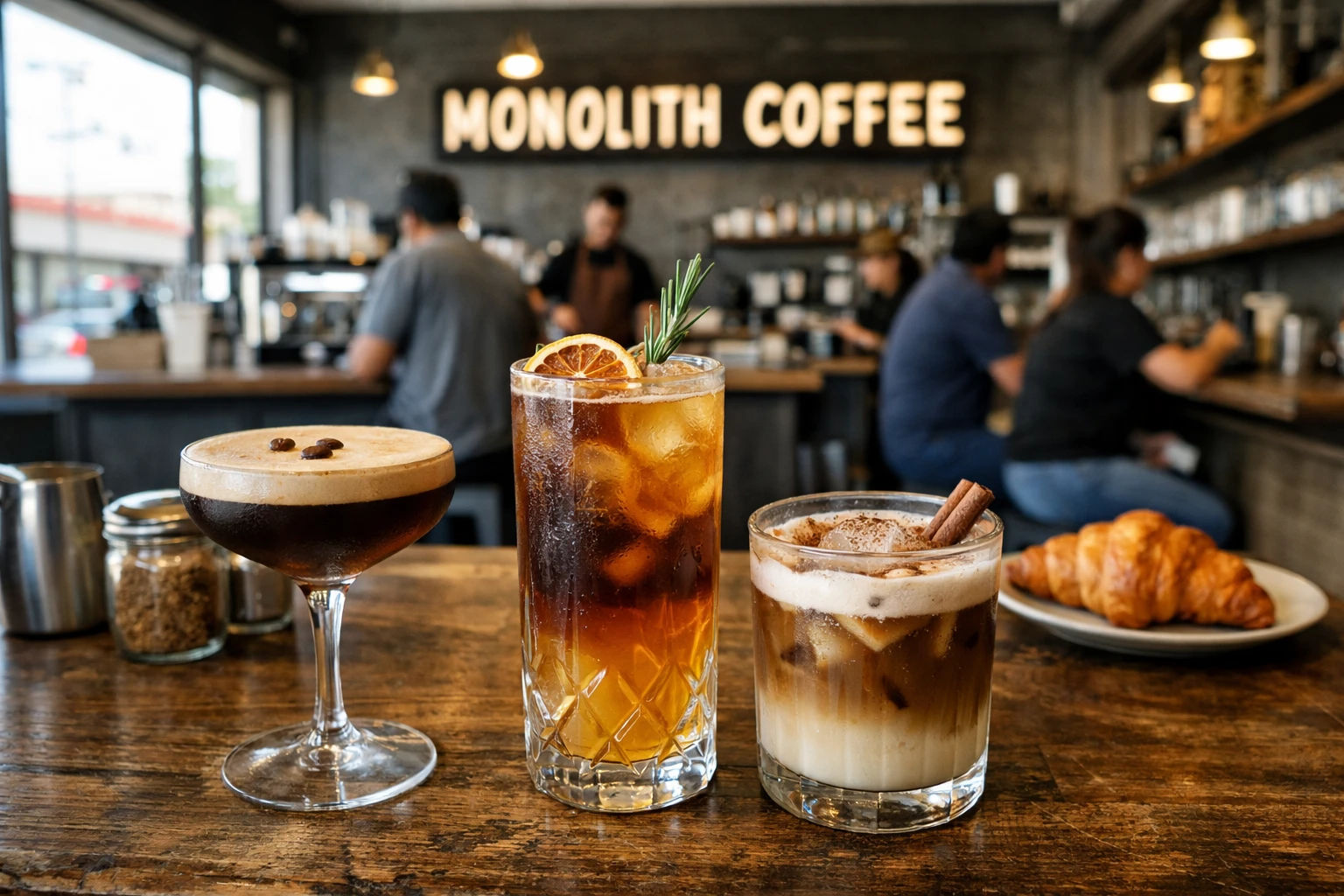
The menu reads like a curated flight. Standouts include the Rush, a nitro-infused layered espresso and orange juice drink; Echo, a caffeine-free apple-juice-based composition; Still, a hojicha-forward, umami-driven beverage; and Rift, a smoked cold brew infused with bonito and kombu syrup. Each drink is assembled with a bit of ceremony, so service moves at a deliberate pace.
That last sentence is important for anyone arriving with a 10-minute window and a laptop. This is not a grab-and-go situation. The drinks are built in a specific sequence, the ingredients interact with each other in ways that take time to reveal, and the ritual of the pour and the handoff is part of what you are paying for. Monolith is asking its customers to do something that Los Angeles does not always do well: slow down and be present with a single beverage for a few minutes.
The custom ingredient card that comes with each drink is a small masterstroke of hospitality design. It tells you what is in your glass, in a format more like a cocktail menu at a serious bar than a coffee shop receipt. It gives you something to hold, something to reference, and something to take home as a souvenir of the specific seasonal moment you experienced. When the "In Four Movements" menu rotates in roughly three months, those cards will be small artifacts of a version of the menu that no longer exists.
The Rift, in particular, stands out as a drink that would not look out of place at a restaurant in Silver Lake or the Arts District charging three times as much for it in a cocktail format. Yuzu-spiked cold brew, bonito syrup, and applewood smoke is a combination that belongs to the tradition of Japanese-influenced culinary thinking that has been reshaping fine dining in Los Angeles for years. Applying that same logic to a coffee shop drink on Valley Boulevard in Alhambra is a genuinely interesting cultural move.
The Pastry Program: Hojicha Financiers and Miso Nori Scones
A lesser version of this concept would pair its elaborate drinks with generic croissants from a wholesale supplier. Monolith does the opposite.
Jin's pastry program is built with the same intention as the drink menu. The pastries are designed to play off the menu's savory notes. Hojicha chestnut financiers bring together the roasted, slightly smoky character of hojicha green tea with the earthiness of chestnut in a format, the financier, that is inherently buttery and dense. Miso nori scones take a British baking tradition and run it through a Japanese pantry, producing something that sits in an interesting middle space between savory and sweet that mirrors what the drinks are doing in the glass.
This approach reflects a specific understanding of how a tasting experience works. If you drink The Rift, with its bonito and smoke notes, and then bite into a miso nori scone, you are not just eating a pastry alongside a drink; you are extending a flavor conversation that the drink started. That kind of intentional pairing at a coffee shop is extremely rare in Los Angeles, and it is part of what makes Monolith feel closer to a mini tasting bar than a café.
The carefully curated coffees and teas are the clear stars of the experience, and the menu spans from standard espressos to curated teas to the elevated "Moments," which are rotating caffeinated and non-caffeinated compositions with descriptions written like haiku. The poetry in the menu writing is not affectation; it is a cue about the pace and register the shop is operating in.
The Space: What It Looks and Feels Like Inside
Monolith Coffee looks like someone opened up a café inside the Natural History Museum. Yes, those are rocks dangling from the ceiling.
The Natural History Museum comparison from The Infatuation is the most accurate shorthand available. The stone textures, the hanging geological specimens, the neutral tones, and the compact counter all work together to create a space that feels both scientific and meditative. It is a room designed to make you stop scrolling through your phone, look up, and pay attention to the material world in front of you.
Monolith shares a small shopping plaza just off the intersection of Valley and Garfield. The interior is desert-y chic, and the storefront has a rounded shape with tinted windows that make the interior nearly invisible from the street.
The address is 43 E. Valley Boulevard, Alhambra, CA 91801. Parking in the small plaza is direct and easy, which is a practical advantage over many of the specialty coffee destinations on the Westside of Los Angeles, where parking is a genuine obstacle. The Metro Gold Line, now designated the A Line, stops at the Atlantic station a short walk away, making Monolith reachable by train from Pasadena, Downtown Los Angeles, and East Hollywood without much difficulty.
The shop is currently operating in a soft opening format, with fuller hours expected when the April launch rolls out. Weekend hours and a fuller April launch are on the shop's Instagram page at @monolithcoffeela. Following that account before you go is strongly recommended, both for hours updates and because the visual presentation of the shop on social media gives a useful preview of what the experience will feel like.
Why the San Gabriel Valley Is the Perfect Location for This
Placing a specialty coffee shop with cocktail bar sensibilities on Valley Boulevard in Alhambra is a more considered choice than it might appear to anyone who does not spend time in the San Gabriel Valley.
The SGV is one of the most food-sophisticated regions in Los Angeles County. The concentration of excellent Chinese, Vietnamese, Korean, and Taiwanese restaurants along the Valley Boulevard corridor and in surrounding cities like San Gabriel, Rosemead, and Monterey Park is world-class by any measure. The boba culture that has grown out of this community, centered on tea shops like Gong Cha, Tiger Sugar, and Yi Fang, has shaped what young Los Angeles residents expect from a beverage experience. Ceremony, presentation, and considered ingredient combinations are already baked into the expectations of the audience that walks this neighborhood every day.
What has been less present in the SGV is the intersection of specialty coffee roasting with that same ingredient-forward sensibility. The region has excellent coffee, but Monolith is doing something architecturally different, treating the drink program the way a chef treats a tasting menu, with a philosophy, a seasonal arc, and an intention that extends from the roast to the final garnish.
That positioning creates a first-mover advantage that is genuinely significant. The SGV has the foot traffic, the food-curious audience, and the cultural appetite for what Monolith is serving. It also has a social media ecosystem, driven by the food content creators who document the region's restaurants obsessively, that is perfectly suited to a visually composed, experience-driven coffee shop. The photos circulating on Instagram and Threads since the soft opening are already demonstrating exactly that dynamic.
How Monolith Fits Into the Broader Los Angeles Coffee Story
Los Angeles has spent the past decade building one of the most interesting specialty coffee scenes in the United States. Verve, Go Get Em Tiger, Loquat, Copa Vida, Dinosaur Coffee, and dozens of other roasters and cafés have collectively elevated the standard of what an LA coffee shop can be. The city's relationship with food culture, its proximity to Pacific trade routes that bring interesting green coffees from Japan and Southeast Asia, and its enormous population of food-curious millennials have all contributed to a market that rewards ambition.
Monolith is arriving at a moment when that scene is mature enough to absorb something truly unusual without treating it as a novelty. There is an audience in Los Angeles that has already been to the best pour-over bars and the most Instagram-famous café interiors, and that audience is ready for something that asks more of them. Monolith asks more. It asks you to read a card, sit with a drink, and notice what changes as it warms in your hand.
The "In Four Movements" concept specifically is worth watching over the coming year, because a rotating seasonal menu that changes every three months creates a reason to...