It was supposed to be one of the most exciting moments in Los Angeles dining in years. On Wednesday, March 11, 2026, Noma, an acclaimed restaurant, opened its doors to Southern California foodies for a 16-week pop-up experience at the historic Paramour Estate in Silver Lake. Food lovers across the city had been waiting months for this. Tickets sold out within minutes. The buzz was real.
By the end of the day, the food was the last thing anyone was talking about.
What unfolded on that hillside property on Micheltorena Street was one of the most dramatic opening days in modern restaurant history. A protest, a resignation, the loss of major corporate sponsors, and a reckoning that has been years in the making all collided in a single afternoon in East Los Angeles. And it has set off a conversation that goes far beyond one chef or one restaurant.
What Is Noma and Why Los Angeles Was Paying Attention
To understand why this story hit so hard in Los Angeles, you need to know what Noma represents to the culinary world.
The Copenhagen, Denmark-based restaurant, founded in 2003, has been ranked among the best restaurants in the world and is widely credited with helping popularize New Nordic cuisine, including the use of fermentation and foraging. That is not a small thing. Noma did not just win awards; it reshaped the way chefs and diners think about what food can be.
Chef René Redzepi led Noma to the top ranking on the world's best restaurant list five times. Despite holding three Michelin stars, he eventually closed Noma in Denmark. The Los Angeles pop-up was billed as something of a rebirth, a chance for Redzepi and his team to bring their vision to a new city, using California's extraordinary produce and ingredients as their canvas.
The much-ballyhooed pop-up was set to run until June 26 at Paramour Estate, located at 1923 Micheltorena St., featuring Noma's highly involved tasting menus that highlight California's primo produce and ingredients. The price tag? Reservations reaching $1,500 per person. The six-week run sold out in just minutes.
For Angelenos who follow the fine dining world, this was the kind of event that gets whispered about at Republique brunches and debated in line at Gjusta. It felt like a once-in-a-generation visit from a restaurant that had genuinely changed the world.
Then the real story arrived.
The Protest Outside Paramour Estate
When the world's most lauded restaurant landed in Los Angeles this week, its multi-course feast, breathless tasting notes, and Instagram-ready shots of impossibly delicate dishes paled in comparison to an off-menu controversy unfolding outside its doors.
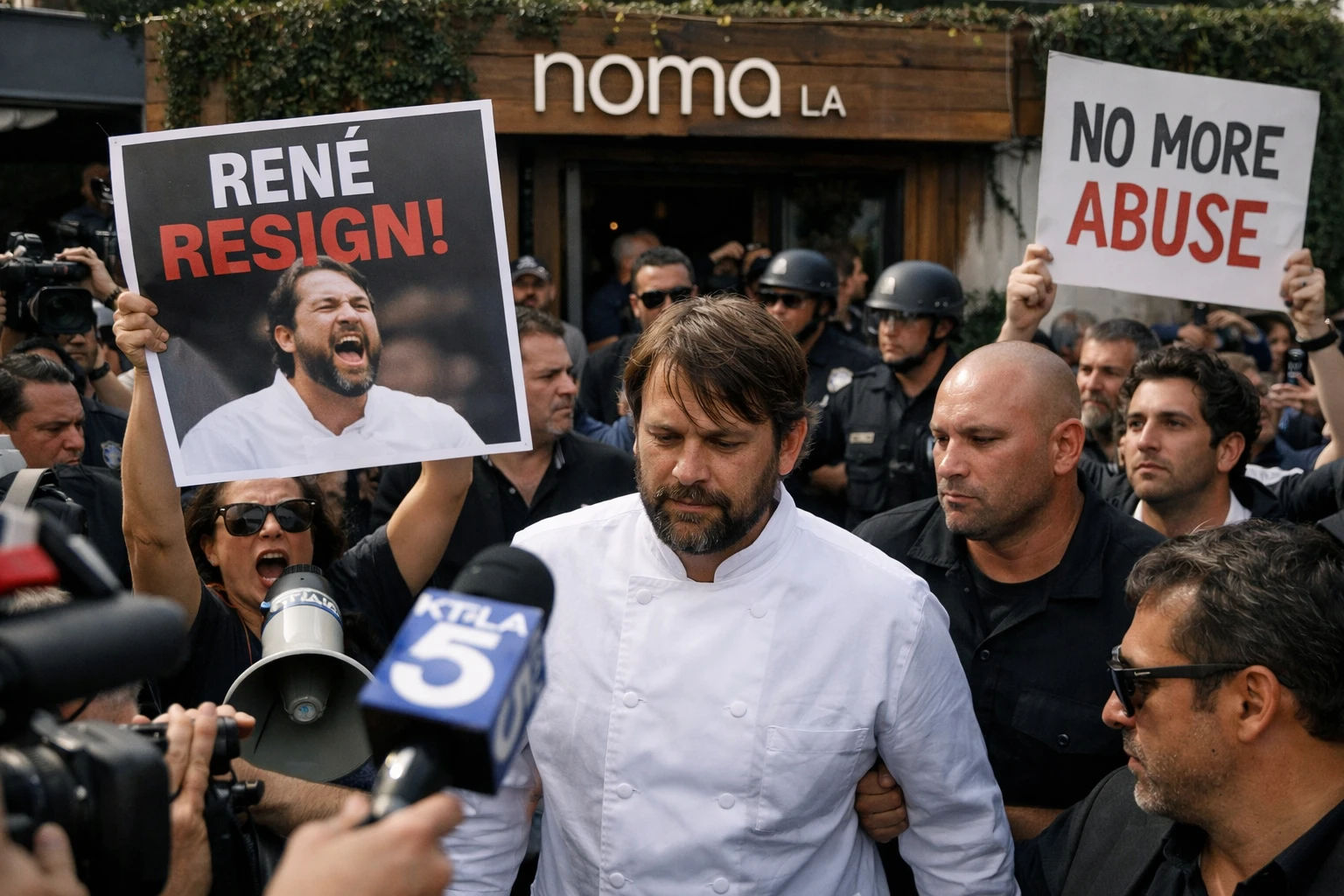
The demonstration was organized by former Noma employee Jason Ignacio White, who previously headed the restaurant's fermentation lab, along with the wage-advocacy nonprofit One Fair Wage. White did not show up quietly; he came with a purpose and with a community of people who had clearly been waiting for this moment.
A dozen former workers and workers' rights advocates protested outside this exclusive pop-up event in Silver Lake, detailing claims of employees being emotionally and physically abused. "Workers being pushed beyond their limits, workers being punched and choked, workers being humiliated and dreams being broken," said former chef and Director of Fermentation at Noma, Jason Ignacio White.
White's account carries weight because he spent years inside that kitchen. He was not a disgruntled staffer with a grudge; he ran the fermentation program at one of the most technically demanding restaurants on the planet. When he speaks about what he witnessed, people in the industry listen.
"I watched people stay in an abusive environment because they had no other choice. They needed the paycheck. They wanted the reference. They feared blacklisting and deportation," Ignacio White added. "More than 50 workers around the globe have come forward since the bombshell revelations were reported."
That number, over 50 people from around the world, is not a rumor; it is a pattern.
Organizers said they intend to deliver a letter to chef René Redzepi calling for dialogue, reparations for workers who say they were harmed, and broader structural changes to address what advocates describe as exploitative labor practices in the restaurant industry.
One Fair Wage, the nonprofit behind the action, framed this as more than a personal grievance against one chef. "Behind the glamour of fine dining is an industry where too many workers experience intimidation, harassment, and wage theft," said Saru Jayaraman of One Fair Wage, in a written statement. "At the root of this toxic culture is poverty pay."
The New York Times Report and What It Revealed
The protest did not come out of nowhere. It was sparked in part by a recent investigation in The New York Times that pulled back the curtain on working conditions inside Noma's Copenhagen kitchen.
The investigation detailed allegations of abusive behavior and exploitative labor practices inside Noma's Copenhagen kitchen from 2009 to 2017. In the report, more than 35 former employees described a workplace culture where intimidation, aggressive behavior, and unpaid labor were the norm inside one of the world's most celebrated kitchens. Many of the former employees claim to have endured punching, kicking, and stabbing, as well as body shaming, public ridicule, and psychological abuse during that period.
These are not vague complaints about a stressful kitchen environment. These are specific, physical allegations from more than three dozen people. And for an industry that has long asked its workers to accept abuse as a kind of dues-paying rite of passage, the Times report landed like a thunderclap.
Noma's response before the opening was measured. A representative for Noma told the Los Angeles Times, "We respect the right to protest peacefully and agree it is important to talk about the culture and standards in our industry." Redzepi himself posted an apology online in the days before opening, acknowledging that his past actions caused real harm while noting he did not recognize every detail in the accounts that had been published.
That qualified acknowledgment did not satisfy the people who showed up outside Paramour Estate on Wednesday morning.
Corporate Sponsors Begin to Walk Away
One of the clearest signals that this story had real financial and reputational weight came from the sponsor response. Several corporate sponsors, including American Express, pulled out of Noma's LA location after the New York Times reported that dozens of former employees accused Redzepi of creating a toxic work environment with constant verbal and even physical mistreatment.
American Express is not a small endorser. For a restaurant experience priced at $1,500 per person, corporate partnerships are part of how these events are packaged and marketed to the upper tier of diners in Los Angeles. When a brand like that exits, it sends a signal to other partners, to future guests, and to the broader hospitality industry about what kind of association is no longer tenable.
That plan appeared to disintegrate by Tuesday, when some event sponsors pulled out and refunded their customers. The evening before opening day, the ground was already shifting beneath the pop-up.
René Redzepi Steps Away on Opening Day
Then came the announcement that nobody expected to arrive so quickly.
Hours later, Redzepi announced he was stepping away from his iconic Danish restaurant that won three Michelin stars and other international accolades for its innovative New Nordic cuisine.
In a statement posted to Instagram, Redzepi addressed both the abuse allegations and his decision to exit. "After more than two decades of building and leading this restaurant, I decided to step away and allow our extraordinary leaders to now guide the restaurant into the next chapter," Redzepi said on social media, promising fans the new team will "carry forward together" into its L.A. residency.
He also acknowledged that whatever changes he had made in recent years could not undo the past. His statement read in part: "The recent weeks have brought attention and important conversations about our restaurant, industry, and my past leadership. I have worked to be a better leader, and Noma has taken big steps to transform the culture over many years. I recognize these changes do not repair the past. An apology is not enough; I take responsibility for my own actions."
It was a remarkable moment. A world-famous chef, on the opening day of a sold-out pop-up in one of the most food-obsessed cities in the world, announcing his own departure. For context, this is roughly the equivalent of a legendary musician stepping away from a sold-out world tour on the night of the first show.
The protesters outside were not ready to declare victory. "We will not accept damage, magical PR attempts to hide the truth of what he has done to me and my peers," White said. He made clear that legal action could follow if demands for a settlement and management changes were not met.
The Pop-Up Continues. The Questions Remain.
Despite everything, Noma Los Angeles is still open for dinner.
Representatives for the restaurant told the Los Angeles Times that the Noma pop-up would continue as scheduled. The tasting menus will still be served. The $1,500 tickets that sold out in minutes will still be honored. The team that Redzepi spent years building will carry the experience forward through June 26.
Whether guests can fully separate the food from the story is a very Los Angeles question. This city has always lived comfortably at the intersection of culture, ethics, and appetite. Angelenos were arguing about whether to eat at Sqirl during the moldy jam controversy. They debate sourcing and labor practices at the farmers market. They have opinions about restaurant workers that go beyond Yelp stars.
As Noma stages one of the most expensive dining events that Southern California has ever seen, labor advocates say the allegations raised in the New York Times reflect a continuing reckoning across the dining world.
That reckoning is not unique to Noma. The fine dining industry has a well-documented culture of demanding brutal hours, dismissing abuse as toughening, and structuring its labor on the backs of underpaid and often unpaid workers. What makes the Noma situation different is the scale of the institution and the size of the price tag on the plate. When a restaurant charges $1,500 per guest, the argument that the economics leave no room for fair pay becomes very hard to sustain.
What Los Angeles Workers and Diners Are Saying
The Paramour Estate sits on a hill above Silver Lake Reservoir, a neighborhood that has always carried a particular LA energy: creative, conscious, and attuned to questions about who gets to take up space and at whose expense. It is, in some ways, the most fitting address in the city for this conflict to unfold.
"Who wants to eat in an environment of abuse," said Saru Jayaraman of One Fair Wage. "Who wants to eat food that comes from the tears and sweat of people who are suffering?"
That question has been echoing through Los Angeles restaurant circles since Wednesday. It is being asked by chefs in Koreatown, line cooks in Boyle Heights, and food writers from Culver City to Pasadena. It goes well beyond Noma.
The broader Los Angeles restaurant industry, which employs hundreds of thousands of workers across the county, is itself facing pressure on wages, conditions, and accountability. The ongoing fight for a higher minimum wage and expanded protections for hospitality workers is very much alive at City Hall. What happens at a $1,500-a-head pop-up in Silver Lake may feel far removed from a line cook at a taco spot on Cesar Chavez, but they are connected by the same industry culture that has allowed abuse to persist in kitchens at every price point.
Where Does Fine Dining Go From Here?
The Noma situation is not just about one restaurant or one chef. It is a stress test for the entire philosophy of fine dining as it currently exists.
While restaurants like Noma, which achieved three-star Michelin status among other accolades, helped redefine global cuisine and turned chefs into icons, they also took part in an industry long criticized for unpaid labor, punishing hours, and hierarchical kitchens where young cooks endure abuse in exchange for rarified knowledge and advancement in the restaurant world.
That trade-off—abuse tolerated in exchange for prestige and access—has been treated as an open secret in professional kitchens for decades. The difference now is that the people who endured it are no longer staying silent, and platforms exist for those voices to reach a wide audience fast.
What protesters and advocates are asking for is not radical by any reasonable standard: fair wages, zero tolerance for violence, reparations for workers who were harmed, and greater transparency in management. These are basic workplace standards in virtually every other industry. In fine dining, they are apparently still controversial enough to require a protest outside a gated Silver Lake estate.
White and his colleagues have set a deadline. If their demands are not met, they have indicated they intend to pursue legal action. That means this story is almost certainly not finished. It will play out over the coming weeks, alongside the tasting menus, the Instagram posts from inside the dining room, and the ongoing demonstrations on Micheltorena Street.
A Defining Moment for the Los Angeles Food Scene
Los Angeles has spent years building a reputation as one of the most dynamic and forward-thinking food cities in the world. The city has produced James Beard winners, launched global restaurant brands, and proven time and again that its culinary identity is as layered and complex as its population. It has also become a city increasingly willing to hold power accountable—in entertainment, in politics, and yes, in food.
The Noma opening did not go the way anyone planned. But in its chaos and controversy, it may have done something valuable. It put the question of who pays the real price for world-class dining directly in front of the diners who are actually paying for the meal. That is an uncomfortable place to sit. It is also exactly where the conversation needs to happen.
The dishes at Paramour Estate will be extraordinary, almost certainly. The produce from California farms will be exceptional. The fermentation and foraging techniques that made Noma famous will be on full display. But the kitchen's greatest contribution to Los Angeles dining this spring may not be anything on the plate. It may be the conversation happening just outside the front gate.
If you care about food in this city, about the people who grow it, prep it, plate it, and serve it, this is a story worth following until the very last night of service on June 26.