Hollywood's Shift: Simi Valley Rising
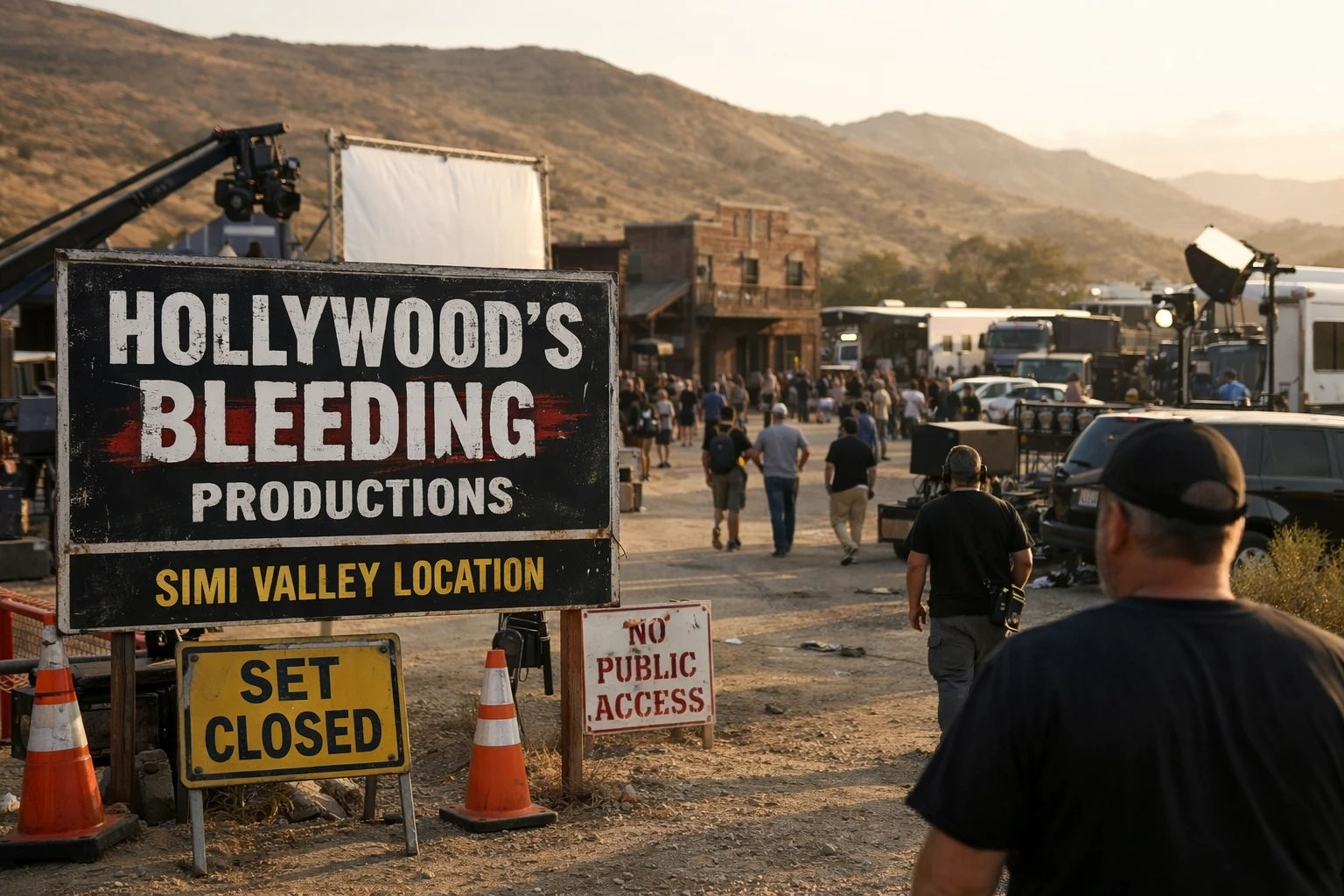
Thirty miles northwest of Hollywood, past the 118 Freeway, past the Ronald Reagan Presidential Library on the ridge above the valley, past the last stretch of suburban sprawl before the landscape opens up into rolling brown hills and old ranch land, something unexpected is happening. The cameras are rolling.
After years marked by a pandemic, two industry strikes, and rising tax incentives in other states, TV and film shoots in the city of Los Angeles have dropped sharply. Yet just over the county line, Simi Valley is booming.
Data provider Luminate released its annual report showing, in its own words, a "staggering" 24 percent drop year-over-year in major scripted film and TV projects shooting in Los Angeles. That number has been circulating through the industry for weeks, and every time it surfaces in a conversation between crew members, producers, or studio executives, someone uses the word "crisis." Not "challenge." Not "headwind." Crisis.
Meanwhile, in Simi Valley, a city of roughly 130,000 people that most Angelenos primarily associate with the Reagan Library and their commute on the 118, the entertainment industry found something it had stopped expecting to find close to home: a welcome mat.
With 296 production days in 2025, filming generated an estimated $5.25 million in economic impact, further strengthening the city's reputation as a premier filming destination. A combination of diverse landscapes and a film-friendly environment attracted 87 productions last year, delivering economic activity throughout the community.
This is the story underneath the headline about Hollywood's decline, and it is more nuanced and more locally specific than the cable news version suggests.
The Numbers Behind Hollywood's Freefall
Before getting to Simi Valley's rise, the scale of Los Angeles's decline deserves to be stated clearly, because the numbers are genuinely alarming for anyone whose livelihood connects to the entertainment industry.
The region recorded just 19,694 shoot days in 2025, the lowest figure observed outside of 2020 when filming was halted amid the pandemic. That is slightly more than a 16 percent drop-off compared to the previous year, continuing a decline in local filming that has been building since the highs of 2018.
The category-by-category breakdown is even more striking. Television production fell 30.5 percent to 1,670 shoot days in Q1 2025 alone, and feature film production fell 28.9 percent. Each drop reflected the impact of global production cutbacks and California's ongoing loss of work to rival territories.
Filming for TV shows ended 2025 over 50 percent below the five-year average. Features fared better but not by much, with the category recording a drop-off of more than 31 percent in the same span.
Those numbers translate directly into human terms. The average number of film and TV production jobs in California in Q1 2025 was 92,000, down 35 percent from 2022 and nearly 20 percent lower than a decade ago. Stage occupancy in the region, which held steady between 93 and 95 percent annually from 2018 to 2021, fell sharply to 63 percent in 2024.
That stage occupancy figure is perhaps the most visceral indicator of what is actually happening. Soundstages that were fully booked for years are sitting partially empty. The vast infrastructure of Hollywood — the stages, the equipment houses, the costume shops, the catering companies, the transportation coordinators, the prop warehouses, the hair and makeup studios that exist because productions need them every single day — is now running at a significantly reduced load.
The crew members who live in the San Fernando Valley, in Chatsworth, Northridge, Granada Hills, and Porter Ranch, are the people feeling this most directly. They are the drivers, the gaffers, the set decorators, the camera operators, the location scouts who built careers around being able to live in the Valley and work within a reasonable commute of Hollywood. Their proximity to the industry was always their advantage. The industry moving is not a theoretical concern for them; it is a changed weekly schedule and a reduced take-home.
Why Simi Valley and Not Atlanta?
The narrative around runaway production always focuses on the far-flung destinations: Georgia's 30 percent tax credit, New Mexico's aggressive incentive programs, the UK and Australia's increasingly generous rebates for large-budget productions. That narrative is real, and the international picture is striking.
Between 2018 and 2025, of the 155 big-budget films released or slated for release, only 34 filmed any portion in Los Angeles, and very few shot entirely in the city. Non-U.S. productions have steadily grown their share of output, and for Netflix, more than half of all series premieres since 2022 have originated from international markets.
But the Simi Valley story is something different and, in some ways, more interesting, because it involves productions that are not leaving the region at all. They are staying within the Southern California ecosystem, within driving distance of the studios, crews, and vendors. They are simply crossing a county line.
Simi Valley sits within the industry's union-mandated 30-Mile Zone, cutting travel costs and making the city even more attractive for shoots.
The 30-Mile Zone, commonly called the TMZ in the industry, is the geographic boundary around the intersection of Beverly Boulevard and La Cienega within which productions do not have to pay travel time or lodging expenses for union crew members. It extends north well past Simi Valley, which means a production filming at Allied Studios in Simi Valley is paying the same basic labor cost structure as one filming on a soundstage in Burbank.
That fact alone changes the economics of the comparison. A production choosing between a permit-intensive Los Angeles location with higher filming fees, more neighborhood restrictions, more street closure complexity, and a city bureaucracy that has been under sustained criticism for its permitting speed, versus Simi Valley's streamlined process, lower fees, and proactively film-friendly city government, is making a decision that does not require any sacrifice in the labor cost column.
Allied Studios: Infrastructure in Place
One of the least-reported aspects of the Simi Valley story is that the city has been building production infrastructure for years, and what is there now is genuinely substantial.
"Filming is alive and well here in Simi Valley," said City Manager Samantha Argabrite during a visit to Allied Studios, a sprawling facility that is home to acres and acres of backlots and finished stages.
Allied Studios is not a new facility. It has served as a production location for decades, and the backlot and stage combination it offers at Simi Valley rates represents a straightforward value proposition for productions that need both interior shooting space and the kind of open exterior terrain that is increasingly scarce and expensive to access within the city of Los Angeles.
Simi Valley also has Hummingbird Ranch, the setting for the Jennifer Garner series "The Last Thing He Told Me," and Corriganville Park, where Quentin Tarantino rebuilt Charles Manson's hideout for "Once Upon a Time in Hollywood."
Both of those location credits are meaningful reference points, not just for their headline value but for what they signal to location scouts and production designers. Hummingbird Ranch's varied terrain provides the kind of rural California landscape that productions consistently need and consistently struggle to find within Los Angeles city limits without driving into genuine wilderness. Corriganville's historical significance as a former Western movie ranch, combined with its adaptable terrain, gives it the kind of flexibility that makes it useful across genres.
The City Council recently formed an ad-hoc committee to help ensure filming in Simi Valley continues to thrive and grow into 2026 and beyond. Located within the Los Angeles 30-Mile Studio Zone, Simi Valley offers a wide range of scenic backdrops, unique locations, and a streamlined permitting process, making it an attractive choice for productions of all sizes.
The ad-hoc committee is the most significant institutional signal in the Simi Valley story. This is a city government that has decided, consciously and at the council level, that production is a strategic priority and that the organizational structure to support it needs to be in place before the demand arrives rather than after. That is the opposite of what Los Angeles has done for most of the past decade.
The Real Impact of $5.25 Million
The economic impact figure of $5.25 million from 296 production days deserves context, because at first glance it reads as modest against the backdrop of Hollywood's billion-dollar budget discussions.
"It might not sound like a lot by Hollywood standards, but it adds up quickly in a small community like Simi Valley," said City Manager Argabrite. "It's creating jobs for our community. We're seeing businesses, restaurants, gas stations, all of which are getting a boom from being here in Simi Valley and benefiting from the productions that happen here."
The street-level experience of that number is best captured by the people working within a few blocks of Allied Studios. Wendy Brazen, a waitress of 19 years at the Old Susana Café just down the street from Allied Studios, said crews have become familiar faces. "There's people here right now that are from the studios," she said. "I enjoy them. They're super fun, and they bring business to us."
A 19-year waitress who has watched the neighborhood around the studios closely enough to know when production activity shifts is exactly the kind of ground-level economic indicator that production incentive discussions usually ignore. The crew lunch spending, the coffee runs, the gas fill-ups, the supply store visits, the occasional hotel room for an out-of-town department head: these are dispersed, daily, and cumulative in a way that matters significantly to a smaller commercial corridor.
The ripple effect of 296 production days across 87 productions is not a single $5.25 million check delivered to city hall. It is 87 different production crews, each of them spending money every day on the things that productions spend money on, in a community that has set up its systems specifically to make that spending easy.
Several notable projects, including for Apple TV, are already permitted and scheduled to begin filming in the coming weeks. An Apple TV production is not a marginal commercial or a small independent; it is a significant streaming project with a crew and budget that will amplify every economic ripple the 2025 numbers have already shown.
Los Angeles: A Response in Motion
The city of Los Angeles is not watching this passively. All eligible council members voted to approve colleague Adrin Nazarian's seven initial motions to "keep Hollywood home." Those include measures to speed up soundstage certification, require city departments to report compliance with Mayor Karen Bass's 2025 executive order on filming, launch an independent audit of the permitting system, and usher in free "microshoots" involving ten or fewer people. Additional motions will facilitate agreement with LA County and local cities to coordinate permit regulations, require the tourism department to present a "Made in LA" branding campaign idea to the Council, and work to unify filming conditions across the city.
These measures reflect a belated recognition that the permitting system, which Los Angeles has historically treated as a revenue source rather than a service, has become a competitive liability. The independent audit of the permitting system is the most significant of the motions, because it acknowledges what location scouts and production coordinators have been saying quietly for years: the process of getting a permit to film in Los Angeles is slower, more expensive, and less predictable than the process in competing locations.
FilmLA said there is reason for hope thanks to California's recently revamped Film and Television Tax Credit Program, noting that the office has "consistently projected that the full effect of the expanded Film and Television Tax Credit Program would take time to materialize."
Governor Newsom's expansion of the California tax credit program, which increased the annual cap and broadened eligible production categories, is the state's primary policy response to the production decline. The credit itself is real and meaningful for qualifying projects. The limitation is the timeline. Tax credits that require applications, processing, and annual caps create uncertainty for productions that need to make location decisions months in advance.
There's also a question of time, as many productions do not have the luxury to wait for those magic tax credits to materialize. Some of those productions are not moving very far, but they are leaving regardless.
That sentence is the core of the Simi Valley story in a single line. The productions drifting to Simi Valley are not waiting to see if LA's reform promises materialize. They are making practical, near-term decisions based on the conditions that exist today.
Hollywood's Identity Crisis
There is a version of this story that is only about economics: permit costs, tax credits, shoot days, stage occupancy. That version is important and accurate.
But there is a larger question sitting underneath all the data, and it is one that the entertainment industry has been avoiding with considerable skill: what does it mean for Hollywood's identity when the physical act of making films and television moves away from the geography and the community that gave the industry its name?
Hollywood is not just a neighborhood in Los Angeles. It is an idea, a shorthand for the concentrated creative and economic ecosystem that the global entertainment industry built in Southern California over a century. The Paramount lot on Melrose. The Warner Bros. lot in Burbank. The Sony lot in Culver City. The CAA building on Avenue of the Stars. The agencies and management companies and talent lawyers on Wilshire and Sunset who make the deals that put productions into motion. All of that infrastructure is still here, still running, still central to how the global entertainment industry operates.
But the actual making of things — the crews on set, the cameras rolling, the locations being transformed, the catering trucks arriving at 5 a.m., and the days that turn into nights of standing light and focused work — that physical activity is increasingly happening somewhere else. Sometimes 6,000 miles away in London or Sydney. And sometimes 30 miles northwest in Simi Valley.
The crew members who live in the Valley understand the local version of this shift intuitively. Their commute to work has changed. Some of them are driving north on the 118 to jobs that used to require driving south on the 101. For now, that is a manageable change. The work is still within reach. The 30-Mile Zone still applies. The paychecks still come from recognizable companies.
What they are watching carefully is whether the drift continues. Whether the 87 Simi Valley productions of 2025 become 150 in 2027. Whether Allied Studios expands its stage capacity because the demand justifies the investment. Whether other Ventura County cities, watching Simi Valley's numbers, begin their own film-friendly infrastructure campaigns. Whether the permitting reforms Los Angeles approved last month come with enough operational change to make a real difference to the location scouts making decisions right now.
What to Watch Next
The Apple TV production permitted for Simi Valley in the coming weeks is a meaningful data point to follow, not because a single streaming production changes the overall numbers, but because Apple's location decisions carry reputational weight in the industry. When a major platform chooses a specific location, other productions pay attention.
The Los Angeles City Council's permitting audit, once complete, will either confirm what the industry has been experiencing or provide data that complicates the narrative. Either way, the findings will matter for the policy response.
And the California Film and Television Tax Credit Program's expanded parameters will start to show up in production decisions over the next 12 to 18 months as projects that applied for the expanded credits begin physical production. If the credits are working, the FilmLA numbers for 2026 should reflect it in some degree. If they are not, the conversation about what Los Angeles is willing to do differently will need to become considerably more urgent.
For now, Simi Valley is filming. Hollywood is watching. And the Old Susana Café on the road outside Allied Studios is doing a steady business from people who drove up from the industry that built the city 30 miles to the south.
FilmLA publishes quarterly on-location production reports for the Greater Los Angeles area at filmla.com. The Luminate annual report is available at luminatedata.com. For information on Simi Valley filming permits and production resources, contact the City of Simi Valley Economic Development Division at simivalley.org.