Newsom Commits $65 Million to Convert Empty LA County Buildings Into Mental Health Campuses
There is a sprawling, 162-acre property in Norwalk that has sat mostly vacant for years. Its buildings are boarded up, and its grounds are overgrown. However, the campus itself, part of the Metropolitan State Hospital complex, has a history that stretches back more than 110 years, and the infrastructure is still standing. On March 6, 2026, Governor Gavin Newsom stood at that campus with Los Angeles County Supervisor Janice Hahn and a gathering of state and county leaders, announcing that what has been sitting empty is about to become something the region urgently needs.
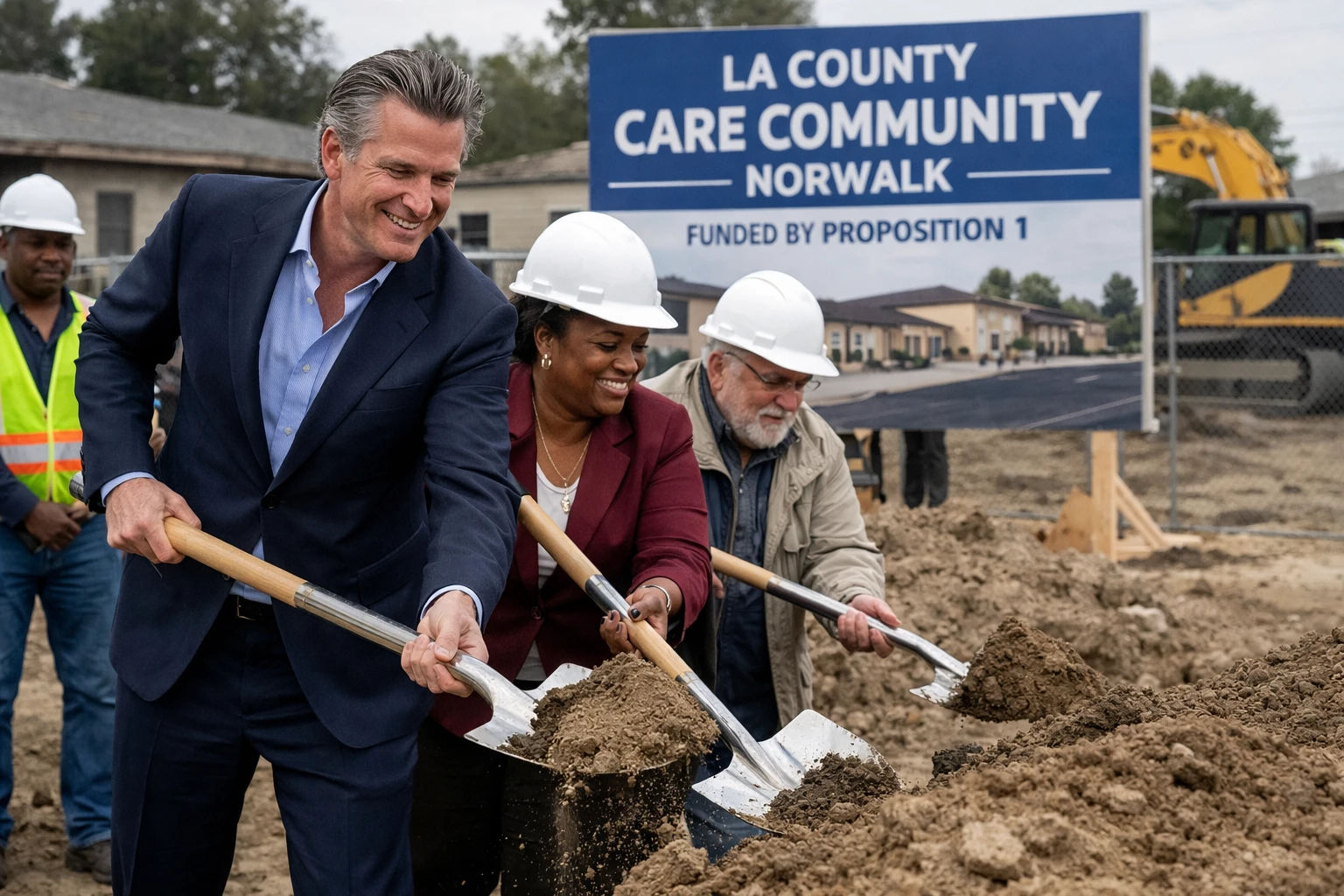
Governor Gavin Newsom announced the groundbreaking of the Los Angeles County Care Community, a state-of-the-art behavioral health campus that will transform six vacant buildings into a unified mental health and housing community providing 162 housing and treatment beds. The project is supported by a $65 million investment through the Behavioral Health Infrastructure Bond Act under Proposition 1.
For Angelenos who have watched the mental health and homelessness crisis deepen over the past decade, this is the kind of news that resonates more profoundly than a mere press release. Real buildings, real beds, and a real groundbreaking ceremony with shovels in the ground, backed by a funding source that voters themselves approved because they wanted to see exactly this kind of action.
Why Los Angeles Desperately Needs More Mental Health Beds
Before delving into what the LA County Care Community will actually be, it is worth stepping back to understand the scale of the problem it aims to address.
More than 60% of LA's unhoused population is affected by a diagnosable mental health condition. This statistic is not about a distant crisis; in Los Angeles, it is visible from the 10 Freeway, on sidewalks in Skid Row and East Hollywood, under the underpasses in the San Fernando Valley, and along the riverbanks from Glendale to Long Beach.
The 2025 Los Angeles Homeless Services Authority count found 67,777 people experiencing homelessness across the Los Angeles Continuum of Care, with the largest concentrations in Metro Central Los Angeles at 25%, South Los Angeles at 20%, and the San Fernando Valley at 16%. Despite a 4.1% overall decrease from 2024, the numbers remain staggering, and the proportion of that population dealing with untreated mental illness and substance use is substantial.
The bed shortage behind these numbers is measurable. According to a 2021 RAND Corporation study, California requires approximately 50 inpatient mental health beds per 100,000 people. Los Angeles County has a shortage of 5.6 beds for short-term psychiatric holds and a shortage of 11.6 beds in residential care facilities per 100,000 people. "We remain thousands of mental health beds short of our current needs," said Fifth District Supervisor Kathryn Barger.
Thousands of beds short. Not dozens—thousands. That context makes the 162 beds coming to Norwalk feel less like a complete solution and more like an important first step in what needs to be a sustained, long-term buildout.
Across California, individuals with untreated psychosis are 10 times more likely to experience homelessness and 16 times more likely to be incarcerated. The connection between untreated mental illness and the outcomes that Los Angeles residents see every day on their streets and in their neighborhoods is direct, documented, and well understood by everyone working on these issues. What has been missing is infrastructure and funding at a sufficient scale to actually close the gap.
Proposition 1, passed by California voters in 2024, was designed to change that.
What Is Proposition 1 and Why Does It Matter for LA?
Proposition 1 is a $6.4 billion Behavioral Health Bond for housing, services, and treatment for veterans and people experiencing homelessness. It is the largest voter-approved investment in behavioral health infrastructure in California history, and its passage represented a clear mandate from the public that the state needed to stop talking about the mental health crisis and start building the infrastructure to address it.
When fully awarded, funding from Proposition 1 bonds is estimated to create 6,800 residential treatment beds and 26,700 outpatient treatment slots for behavioral health care across California.
Of the statewide allocations, Los Angeles County will receive over $1 billion in grant funding spread across more than 30 projects, supporting a sweeping expansion of behavioral health services designed to serve individuals with serious mental illness, dual diagnoses, and those experiencing homelessness.
The LA County Care Community in Norwalk is the largest single Proposition 1 project to break ground so far. To date, it is the most significant Proposition 1 financed project to commence. That distinction matters. It signals that the state and county are ready to move from planning to construction, and that the $65 million investment in Norwalk is intended as a proof of concept that can be replicated elsewhere in the county and across the state.
Newsom was direct about what this investment represents: "Californians voted for action to address our mental health crisis with Proposition 1, and we're delivering," he said. "We're turning vacant buildings into places of care, adding treatment and housing beds, and helping people get off our streets and into the support they need."
Inside the LA County Care Community: What Will Actually Be Built
The specifics of what is being built in Norwalk are worth understanding because this is not a single facility with a single purpose. It is a comprehensive, layered campus designed to serve people at different points in their journey through the mental health and housing system.
The total project cost is $106 million, made possible with $65 million in state Proposition 1 funding, in addition to other state and county funds. Here is what that investment will create:
Subacute Psychiatric Facilities for Young Adults
Two subacute psychiatric facilities will provide 32 beds funded by the Behavioral Health Continuum Infrastructure Program for young adults ages 18 to 25 with significant mental health needs. This population is often caught in the gap between the adolescent mental health system and the adult system. Young people aging out of foster care, those experiencing first episodes of psychosis, and young adults who have been cycling through emergency rooms without being placed in appropriate care will have a dedicated, secure place for treatment.
Interim Housing with Wraparound Services
A 70-bed interim housing facility with wraparound mental health services will provide the kind of bridge housing that mental health professionals consistently identify as critical for transition. Moving someone from a psychiatric hold to the street has long been a failure point in the Los Angeles system. This facility is designed to break that cycle by providing stable, supported housing while residents continue treatment.
Permanent Supportive Housing
Two permanent supportive housing buildings will provide 60 apartments for adults exiting homelessness. This is where the long-term impact of the project resides. Permanent supportive housing, with ongoing case management and mental health services, is the model with the strongest evidence base for keeping formerly homeless individuals housed over time. Sixty apartments may not seem like a large number relative to the overall need, but each of those units represents a person who will have a real home with real support around them.
A Shared Community Building
A shared community building will provide space for case management, wellness services, and onsite supports. This is the connective tissue of the campus—a central hub where residents can access services, meet with case managers, participate in programming, and receive the kind of coordinated, ongoing support that prevents people from falling back through the cracks after they stabilize.
The Buildings Themselves
The psychiatric hospital at Metropolitan State Hospital opened in 1916 and, at its peak, housed thousands of patients. The 162-acre campus includes overgrown grass and boarded-up buildings, but the architectural features of the structures have historical landmark status. Officials have stated that the plan is to preserve those architectural features, and some of the buildings feature large windows that architectural mockups show will remain intact, allowing light to flow into large indoor communal spaces.
Preserving and renovating these buildings rather than demolishing and rebuilding is both a practical and symbolic choice. These structures have been part of Los Angeles County's attempt to address mental illness for more than a century. Their transformation from abandonment into active care represents a full-circle moment in that long history.
The People Who Made This Happen
The LA County Care Community did not emerge from a single announcement. It is the product of years of advocacy, legislation, and community organizing led by elected officials who decided to push past the usual pace of government.
Under the leadership of Supervisor Janice Hahn, Los Angeles County sought to renovate six vacant buildings on the MSH property to develop a new mental health care community that will serve adults and transitional age youth with varying mental health and housing needs.
Hahn has been the primary driver of this specific project and was unsparing in her diagnosis of the problem it addresses. "One of the biggest challenges we face in Los Angeles County right now is that we simply do not have enough places where people can get the compassionate, professional mental health care that they need," Hahn said before the groundbreaking.
Getting the state to lease the buildings to the county required specific legislation. In 2024, Governor Newsom signed SB 1336 by Senator Bob Archuleta, allowing Los Angeles County to lease vacant buildings at Metropolitan State Hospital and clearing the way for this critical project. Senator Archuleta, who represents the Norwalk area and has long been an advocate for the Metropolitan State Hospital campus, was present at the groundbreaking and has been a consistent voice pushing to put these buildings to work.
California Health and Human Services Agency Secretary Kim Johnson articulated what the investment represents in the broader context of state policy: "Through these investments, we are creating bold, community-driven solutions that expand access to care, promote equity, and meet people where they are. These projects reflect our values and vision for a healthier, more compassionate California."
Dr. Lisa H. Wong, Director of the Los Angeles County Department of Mental Health, framed the significance plainly: "With Proposition 1 funding earmarked specifically for the Metro campus, we can increase our capacity to provide the highest level of mental health services and resources to the individuals in our community."
The Broader Investment Arriving in Los Angeles
The $65 million Norwalk project is the most visible piece of a much larger investment that is reshaping behavioral health infrastructure across Los Angeles County and throughout California.
Governor Newsom announced earlier this week $291 million in funding for housing and behavioral health services statewide, alongside California's recent 9% drop in unsheltered homelessness. That drop, the first significant decline in unsheltered homelessness in California in nearly two decades, reflects both the scale of the investment being made and the early evidence that the approach is producing results.
Proposition 1 is now delivering more than the promised 6,800 residential treatment beds, with 6,919 beds underway, and 27,561 outpatient treatment slots, exceeding the 26,700 target. More than $1.18 billion in additional Bond BHCIP Round 2 funding is expected to be announced this spring.
Beyond the Norwalk campus, Los Angeles County projects funded through Proposition 1 include more than 10 Mental Health Rehabilitation Centers across Glendale, Norwalk, Sylmar, and downtown Los Angeles, as well as over 20 Adult Residential Substance Use Disorder Treatment Facilities, including specialty perinatal and dual-diagnosis programs. Peer Respite Programs led by organizations including SHARE!, Homeboy Industries, and others will provide non-clinical, peer-led crisis care.
The involvement of Homeboy Industries, Father Greg Boyle's celebrated East Los Angeles organization serving formerly gang-involved individuals and the recently incarcerated, reflects a meaningful expansion of who is being included in the state's behavioral health investment. This is not infrastructure being built only through large institutional providers; community-rooted organizations with deep ties in LA's most underserved neighborhoods are part of the fabric of this buildout.
What This Means for Families and Residents Across LA
For families in Los Angeles who have a loved one cycling between emergency rooms, encampments, and the street, news of 162 new beds in Norwalk will feel both genuinely hopeful and painfully insufficient at the same time. Both reactions are valid.
The honest accounting is that 162 beds in a county with tens of thousands of unhoused individuals dealing with serious mental illness is a drop in a very large bucket. The LA County Department of Mental Health is the largest public mental health department in the United States, and it is operating under sustained pressure from every direction.
However, the significance of the Norwalk groundbreaking is not primarily the 162 beds. It is the model. State officials say the project is designed to move people from the streets into treatment and stable housing while strengthening California's behavioral health care system. University leaders and advocates describe the LA County Care Community as a model that will be watched closely to see whether it can be replicated in other parts of the county and state.
A campus that moves people from locked psychiatric care to interim housing to permanent supportive housing, all on a single site with a shared services hub, addresses one of the most persistent failure points in the existing system: the hand-off. Every time someone is discharged from a psychiatric facility into an environment with no housing, no follow-up care, and no connection to services, the treatment they received begins to unwind. The LA County Care Community is designed to eliminate those gaps by keeping people within a single ecosystem of care until they are ready for independence.
That design logic, if it works in Norwalk, can be applied anywhere in Los Angeles County where there is available land, vacant state property, or underutilized public infrastructure. And in a county this size, there is more of that than people typically realize.
A Generational Course Correction in Progress
The history behind what is happening in Norwalk is worth understanding because this investment is not just building new capacity; it is attempting to repair a specific, documented policy failure.
The mental health crisis has its roots in Governor Reagan's administration, when state hospitals were closed and no adequate alternative was provided, leaving people most in need of help to fall into the criminal justice system or homelessness. This created a generational impact.
Deinstitutionalization, the movement to close state psychiatric hospitals that accelerated through the 1960s and 1970s, was supposed to be paired with robust community-based mental health infrastructure. That infrastructure was never adequately built. California, like every other state that went through deinstitutionalization, ended up with fewer inpatient beds, inadequate community services, and a criminal justice system that absorbed the people who had nowhere else to go.
The individuals sleeping on the sidewalks of Skid Row and in the riverbeds of the San Fernando Valley are, in many cases, living with the consequences of that failure. The buildings sitting vacant at Metropolitan State Hospital in Norwalk are a physical artifact of that same history. Turning those buildings into treatment and housing is not just a practical decision; it is a recognition that the damage done by decades of underinvestment needs to be actively repaired, building by building, bed by bed.
What Comes Next: Timeline and Resources for Angelenos
Construction is now underway at the Metropolitan State Hospital campus in Norwalk, with the groundbreaking ceremony marking the formal transition from planning to building. The project is expected to come online in phases, with the different facility types opening as renovation is completed on each of the six buildings.
For Angelenos who want to access mental health resources right now while this infrastructure comes online, the following contacts are available through the Los Angeles County Department of Mental Health.
The LA County Department of Mental Health 24-hour crisis line is available at 1-800-854-7771. This line connects callers to trained mental health professionals who can provide immediate support, information about available services, and referrals for ongoing care. For adults and youth experiencing a psychiatric emergency, the line is available every day of the year with no insurance requirement.
For broader information about the Behavioral Health Continuum Infrastructure Program investments across Los Angeles County, the Department of Health Care Services maintains updated project information at DHCS.ca.gov.
For those following the development of the LA County Care Community and other Proposition 1 projects in the county, updates are available through Supervisor Janice Hahn's office at hahn.lacounty.gov.
"This mental healthcare village is exactly the type of facility voters were thinking of when they approved Proposition 1," said Supervisor Hahn. "These buildings are doing no one any good sitting empty, and we have a plan to convert them into the Los Angeles County Care Community, a mental healthcare village where we can provide humane, professional treatment and housing to people who desperately need it."
Los Angeles has been having the same conversations about mental health and homelessness for years. What is different in March 2026 is that those conversations are now accompanied by shovels in the ground, a signed lease, a funded project, and a model worth watching. That is not everything, but it is a start that is long overdue.
If you or someone you know is experiencing a mental health crisis in Los Angeles, call the LA County Department of Mental Health 24-hour crisis line at 1-800-854-7771. Help is available at no cost, every day of the year.