The LACMA David Geffen Galleries: A New Era Awaits
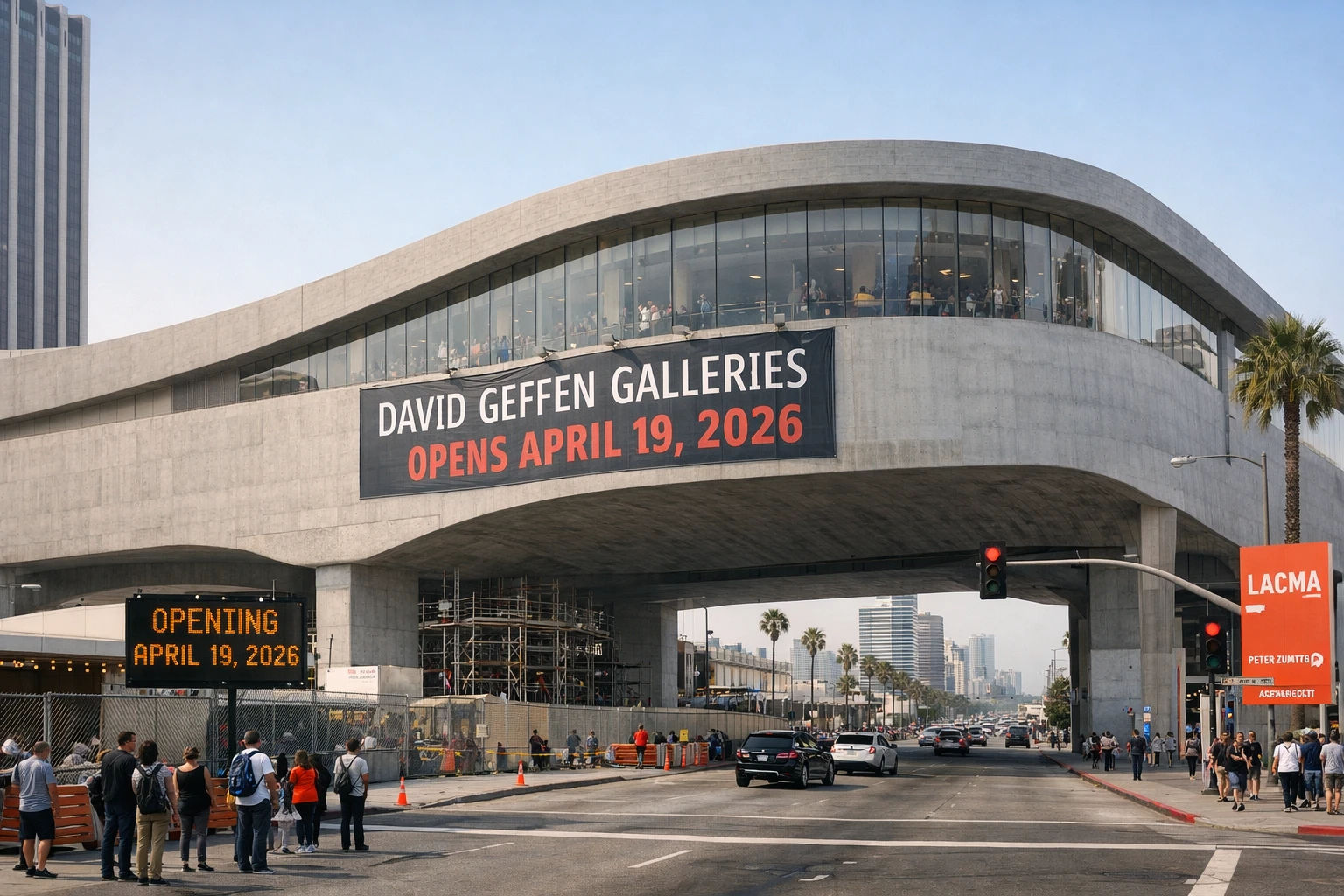
In just twenty-six days, on April 19, 2026, a monumental architectural achievement will unveil itself on Wilshire Boulevard, redefining Los Angeles's cultural landscape. The David Geffen Galleries at LACMA is not merely an addition; it is a 900-foot-long concrete marvel that floats 30 feet above street level, designed by the esteemed architect Peter Zumthor. This new wing boasts more gallery space than the entire LACMA campus did 19 years ago, promising to transform how Angelenos perceive their city and its artistic heritage.
Galerie Magazine has heralded it as one of the most anticipated architectural openings globally in 2026. This sentiment echoes throughout the international architectural community, which has closely monitored the building's evolution since its initial design was revealed in 2013. After 16 years of development, the debut of a Peter Zumthor creation is nothing short of an event.
For residents of Los Angeles, this is more than just an event; it marks the culmination of a generational aspiration for one of the region's premier public institutions. Situated at 5905 Wilshire Boulevard, LACMA houses over 150,000 objects, making it the largest art museum in the western United States. The David Geffen Galleries not only reposition the institution physically but also conceptually, framing Los Angeles as a pivotal site where global art histories converge.
Here is everything you need to know before you go.
The Building: A Vision Realized
Descriptions of the David Geffen Galleries often lean heavily on superlatives and metaphor, which can obscure the reality of the experience. Here’s a straightforward overview.
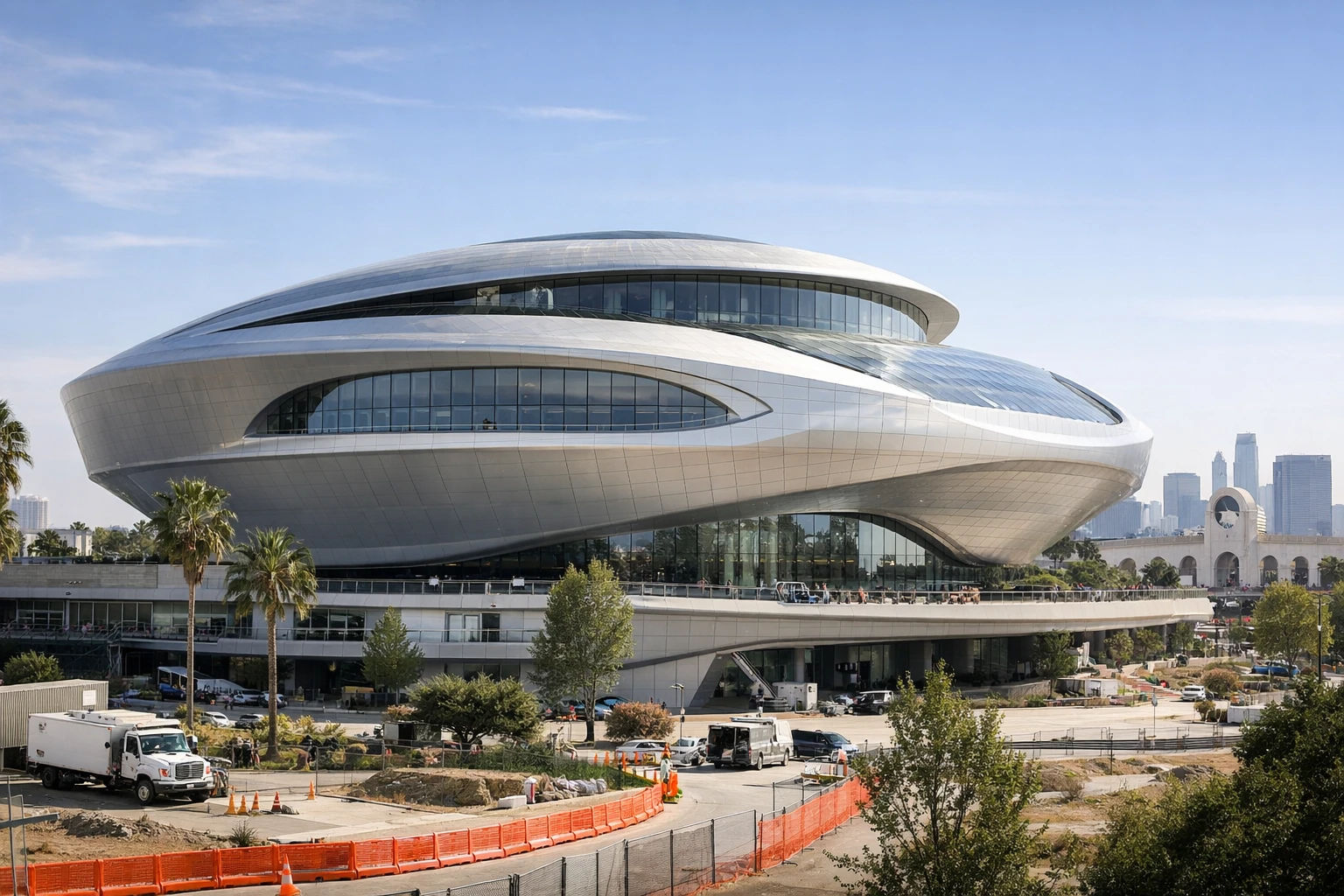
The building undulates gracefully along the eastern edge of the Los Angeles County Museum of Art campus, extending over Wilshire Boulevard with an exhibition floor elevated nearly 30 feet above street level. This glass-and-concrete structure consists of a singular, serpentine form resting atop seven structural pavilions, distributed unevenly across its footprint.
At 900 feet long, it encompasses 110,000 square feet of gallery space on a single level, enabling the museum to showcase approximately 2,500 to 3,000 objects from its extensive collection.
Elevated above plaza level and supported by its seven pavilions, the exhibition area is designed as one expansive, flowing space for art display. LACMA envisions this layout as a means to dismantle traditional cultural hierarchies, placing all artworks on equal footing, both metaphorically and literally. With no designated gallery spaces for specific departments, Zumthor's innovative floor plan allows the institution to adapt its focus over time, responding to scholarly developments, collection growth, and public interest. Moreover, the building's amoeba-like footprint means there is no prescribed path for visitors to follow.
"LACMA's new building refuses the traditional museum experience, inviting visitors to forge their own connections."
This last point deserves emphasis, as it reflects a genuinely unique philosophical commitment. Most encyclopedic museums guide visitors through their collections in a predetermined order, suggesting a correct sequence for experiencing art history. In contrast, LACMA's new building embraces a different approach. The decision to organize the inaugural installation around the world's oceans, rather than adhering to a conventional Western chronological framework, reinforces this philosophy. Visitors are not directed toward which art is more significant; instead, they are encouraged to explore and discover their own connections.
Inside, the walls are composed of gray concrete, an unconventional choice for an art museum, where drywall is typically the norm. Zumthor's choice to utilize architectural concrete as both the primary structure and finished surface lends the galleries a material honesty and sculptural weight that few museum interiors achieve. The concrete does not attempt to recede behind the art; it exists in tandem with it, creating a relationship that is itself worthy of observation.
The building incorporates low-carbon concrete, radiant heating and cooling, natural ventilation, and high-efficiency systems that significantly reduce energy consumption and embodied carbon. Targeting LEED Gold certification, the David Geffen Galleries reflect an institutional commitment to environmental responsibility that is honored by the design itself. The radiant heating and cooling system embedded within the concrete structure is not only more energy-efficient than conventional HVAC systems but also provides greater comfort for occupants.
The Numbers: A Monumental Investment
Named in honor of David Geffen's generous $150 million donation, the new building has also received a $125 million investment from the County of Los Angeles. It creates a low-slung bridge 30 feet above Wilshire Boulevard. The north wing, named after the late philanthropist and collector Elaine Wynn, acknowledges her $50 million contribution that helped launch the museum's capital campaign. In total, LACMA has raised an astonishing $840 million for this project, far exceeding its initial goal.
Peter Zumthor began his initial studies of the east side of the campus in 2009, unveiling the first design for the David Geffen Galleries in 2013. Following this release, the building underwent a significant redesign in 2014 to mitigate potential damage to the nearby La Brea Tar Pits, with additional renderings revealed in 2017.
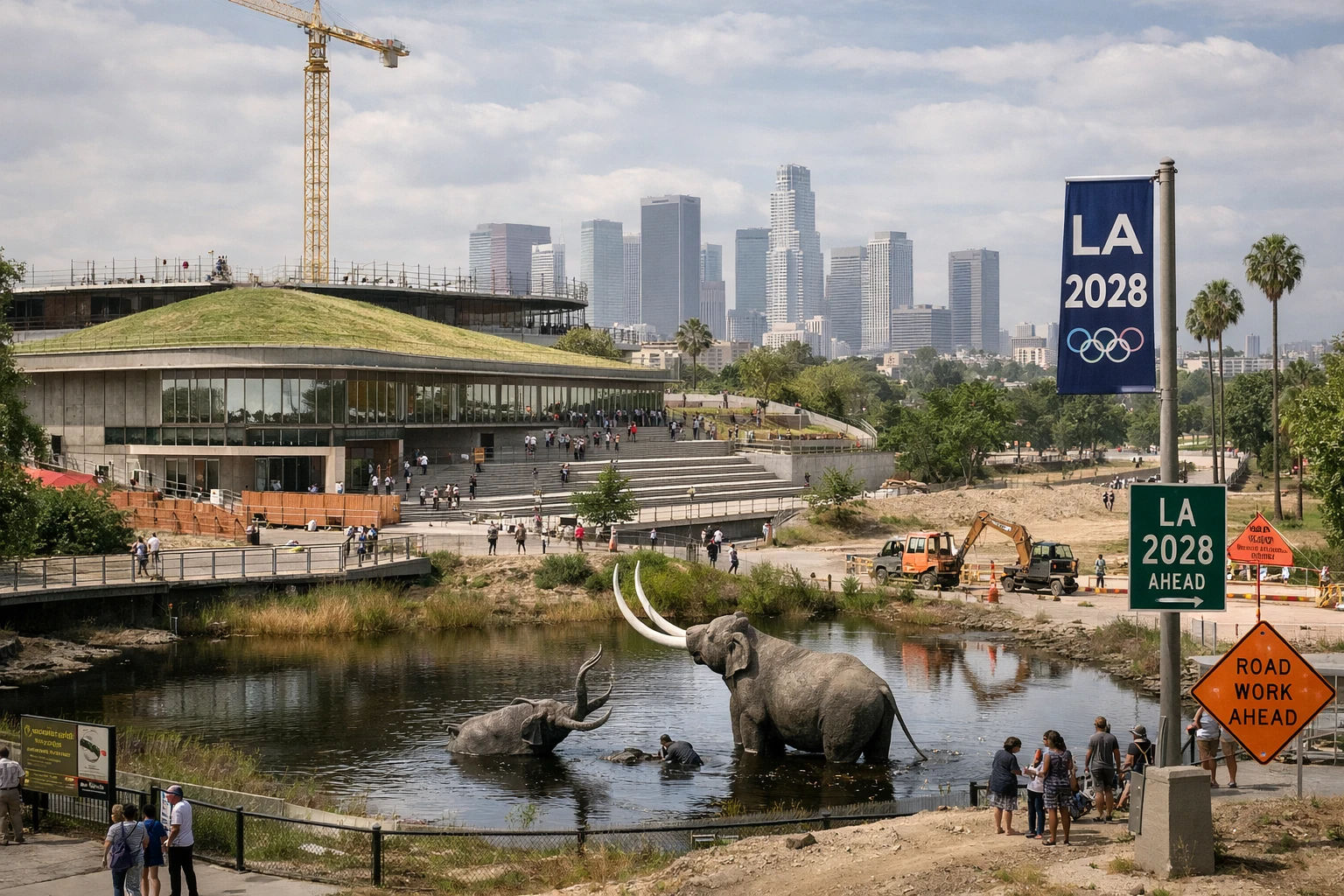
The redesign concerning the La Brea Tar Pits is one of the more unusual engineering challenges in the history of major museum construction. The active tar seeps beneath the Hancock Park campus necessitated specific structural responses to ensure that the building's foundation did not interfere with ongoing fossil extraction and the geological processes that have created one of North America's most significant paleontological sites. The building you will visit in April 2026 was, in part, shaped by the prehistoric creatures whose bones continue to be unearthed from the ground beneath it.
With the David Geffen Galleries, LACMA's total exhibition area expands to approximately 20,440 square meters, up from about 12,080 square meters in 2007. This nearly doubling of gallery space in a single addition represents a transformative shift in the museum's capacity to exhibit its collection rather than merely store it.
The Outdoor Experience: A Community Space
The most significant public aspect of the David Geffen Galleries lies at ground level, where the outdoor spaces are freely accessible and designed for the entire city, fostering a fundamentally different relationship between a major cultural institution and its surrounding neighborhood.
The new Geffen Galleries have created 3.5 acres of park-like public space on both sides of Wilshire Boulevard. The entire ground plane of the 75,000-square-foot expanse of the W.M. Keck Plaza on the north side will feature a commissioned artwork by Mariana Castillo Deball titled Feathered Changes, which will also extend to the south side.
The W.M. Keck Foundation Plaza will serve as a central open-air venue for film screenings, live music, talks, and art activities. Landscaped plazas and sculpture gardens featuring native and drought-tolerant plants, along with site-specific artworks, are integrated throughout the new campus.
Located north of Wilshire Boulevard, East West Bank Commons, named for a generous $10 million gift from Pasadena-based East West Bank and its Foundation, can accommodate events for up to 500 people, both outdoors and under cover. Additional spaces are designed for outdoor concerts, films, and lectures.
The Mariana Castillo Deball plaza commission is more than just landscaping. Castillo Deball is one of the most significant contemporary artists working in site-specific contexts, and transforming the entire 75,000-square-foot plaza into a single commissioned work of art means that every visitor crossing the campus, including those who do not purchase a museum ticket, engages with a major contemporary artwork. This represents one of the most generous public art gestures a major institution has made in Los Angeles in years.
Peter Zumthor will join LACMA CEO and Wallis Annenberg Director Michael Govan in conversation at the East West Bank Commons on April 22 as part of The Genesis Talks. This public conversation, ticketed at $10, offers a unique opportunity to hear from the architect about the building's intentions and his 16-year journey to bring it to fruition. For anyone passionate about architecture, this is the most significant event in the opening program.
The Dining Experience: Culinary Delights Await
The dining offerings at the new LACMA are more diverse and intriguing than typical museum food services, warranting special attention for those planning a full-day visit.
Ray's and Stark Bar will reopen in a new space on the north side of Wilshire Boulevard, funded by donors including Kelvin Davis. Ray's has long been recognized as one of the premier museum restaurants in Los Angeles since its inception at the original LACMA campus. Its relocation to the new building's ground floor provides a dramatically different context while preserving the culinary philosophy and identity that established it as a destination.
Additional restaurants and a café, supported by gifts from Ann Colgin, Joe Wender, Ryan Seacrest, Ashley Merrill, and Marc Merrill, will debut in 2026 on the south side of Wilshire Boulevard. These new dining options significantly expand the food and beverage footprint compared to the previous campus, and the shaded ground-level environment created by the elevated gallery floor above ensures comfortable outdoor dining, even on warm afternoons in Hancock Park.
This comprehensive dining program allows for a seamless day: start with a morning in the galleries, enjoy lunch on the plaza, spend the afternoon in the outdoor sculpture garden, and catch a film screening in the evening at the Steve Tisch Theater. This integrated experience is precisely what the new building was designed to facilitate.
The Steve Tisch Theater: A Cultural Hub
Anchoring the plaza level of the building, the state-of-the-art Steve Tisch Theater, located south of Wilshire Boulevard, will be the new home for LACMA's extensive schedule of film screenings, lectures, discussions, musical performances, and other public programs. Named in recognition of LACMA trustee Steve Tisch's generous contribution to the campaign, it will also function as a gallery during the day, showcasing time-based media works.
A theater that doubles as a gallery during the day and a performance space in the evening represents one of the more architecturally ambitious functional programs within the building. The space must accommodate natural light management for art viewing, acoustic treatment for music and film, and flexibility for the diverse programming that LACMA has historically offered. Its location in the south wing, adjacent to the La Brea Tar Pits, creates a new focal point for the museum's public programming, attracting visitors to an area of the campus that has traditionally experienced less foot traffic than the north side.
Jeff Koons's Split-Rocker: A Living Masterpiece
Jeff Koons's Split-Rocker, a towering 37-foot sculpture adorned with over 50,000 living plants, will become a permanent outdoor landmark adjacent to the new David Geffen Galleries.
This installation of Split-Rocker at LACMA solidifies its status as a permanent fixture within the museum's outdoor campus, rather than a temporary exhibition. The sculpture, which merges the forms of two children's rocking horse toys, is entirely covered in living flowers and plants, evolving with the seasons. This ambitious horticultural and sculptural endeavor creates a striking visual contrast with the precise concrete architecture of Zumthor's design.
The Opening Timeline: Mark Your Calendars
Understanding the opening timeline is crucial for planning your visit, as the initial weeks will feature a structured sequence of access levels.
- April 19, 2026: Ribbon-cutting ceremony kicks off two weeks of priority member access to the galleries and a series of events.
- April 22, 2026: Peter Zumthor in conversation with Michael Govan at East West Bank Commons as part of The Genesis Talks. Tickets available at lacma.org.
- May 3, 2026: Free day for NexGenLA youth membership, providing complimentary access to LA County residents aged 17 and under.
- May 4, 2026: General public opening. The David Geffen Galleries will welcome all visitors.
General admission to the museum is $30, or $25 for LA County residents. Reservations are strongly recommended and can be made now at lacma.org.
If you are a Los Angeles County resident and have not yet become a LACMA member, the two-week preview period from April 19 through May 3 presents a compelling case for joining now. This preview offers a quieter, less crowded experience of the opening, and the annual membership pays for itself after just two visits for most families.
The California Science Center at Exposition Park recently introduced a free museum day that attracts significant crowds. LACMA's May 3 youth free day is likely to generate similar excitement among families with children under 17. If you wish to bring younger children to the opening experience in a more controlled environment, May 3 is specifically designed for that purpose.
The Curatorial Philosophy: A New Approach to Art
The inaugural exhibition occupying these galleries is organized in a manner unlike any previous LACMA exhibition, and this innovation is what much of the pre-opening coverage has overlooked.
LACMA views the building as a means to dismantle traditional cultural hierarchies, placing all works of art on equal footing. The inaugural installation organizes the permanent collection around the world's oceans, rather than adhering to the standard Western chronological and geographic framework. Works from cultures connected by the Pacific, Atlantic, Indian Ocean, and Mediterranean Sea are displayed in proximity based on trade routes, migrations, and cultural exchanges, rather than the art historical periods dictated by European scholarship.
This is not merely an aesthetic choice; it is a statement about whose cultural production deserves a central narrative in a major museum and who has historically been marginalized. For a city as geographically and culturally positioned as Los Angeles, facing the Pacific and boasting the most diverse county population in the United States, an ocean-centered curatorial framework resonates deeply.
Forty-five curators from across LACMA's departments collaborated on this installation, navigating departmental claims over collection objects and achieving consensus on placements that would have been impossible under the traditional gallery structure.
Getting There: Your Guide to Arrival
LACMA is located at 5905 Wilshire Boulevard in the Miracle Mile district of Los Angeles, nestled between Fairfax Avenue and La Brea Avenue on the south side of Wilshire.
By Metro: The D Line subway extension will open its first new stations on May 8, 2026, including Wilshire/Fairfax and Wilshire/La Brea, both of which will place subway riders within two blocks of the new building. After May 8, the combination of the new subway and the new building will create one of the most comprehensive transit-to-museum experiences in Los Angeles.
By car: LACMA offers a parking structure on Spaulding Avenue, one block west of the museum. This structure connects to the campus without requiring a crossing of Wilshire. Street parking on surrounding Miracle Mile blocks is metered. For the opening weekend, it is advisable to arrive before 9 a.m. if you are driving, as parking in this part of Hancock Park becomes significantly more challenging by midmorning on weekends.
By rideshare: The most convenient drop-off point for rideshare services is directly in front of the building on Wilshire Boulevard, particularly near the south side entrance adjacent to the Tar Pits.
Neighborhood context: The La Brea Tar Pits are immediately adjacent and free to explore. The Academy Museum of Motion Pictures is three blocks east, while the Petersen Automotive Museum is directly across the street. The Craft Contemporary is also located across Wilshire. An entire day of cultural experiences in Miracle Mile is accessible without needing to return to your car.
What to Experience First
The inaugural installation is designed without a prescribed sequence, allowing your first decision inside the galleries to be genuinely your own. Here are three starting points worth considering based on your interests.
If you wish to immerse yourself in the architecture before engaging with the art, take a stroll around the full perimeter of the exhibition floor before stopping at any individual work. At 900 feet long, the building gradually reveals itself, and understanding the spatial logic of the various gallery volumes, courtyard spaces, terraces, and the flow between the north and south wings will enhance your art experience.
If you prefer to begin with something familiar, seek out the returning favorites from the previous LACMA galleries: the La Tour Magdalen, the Matisse, and the Van Gogh Tarascon Stagecoach. These landmark pieces provide a comforting anchor from which to explore the surrounding works placed alongside them in the new curatorial framework.
If you are eager to discover something new, focus on the commissioned works by Lauren Halsey, Todd Gray, Sarah Rosalena, Do Ho Suh, and Diana Thater. These pieces have never been seen in this museum context before. Halsey's work, in particular, which engages with Black Los Angeles history and architectural form in ways that resonate deeply with this city, is an ideal starting point for anyone seeking to understand what the new LACMA conveys about its relationship with the community.
The Bottom Line: A Historic Opening
Zumthor's innovative floor plan allows the institution to adapt its focus over time, responding to scholarship, collection growth, and public interest.
What opens on April 19 is not a final statement; it is a framework for ongoing dialogue that will evolve over years and decades as various curatorial visions fill and refill the 110,000 square feet of gallery space. The inaugural installation is merely the first chapter, not the entire narrative.
However, the building itself—a 900-foot concrete span above Wilshire Boulevard, the 3.5 acres of public plaza, the seven pavilions housing restaurants, a theater, and a commons for gatherings of up to