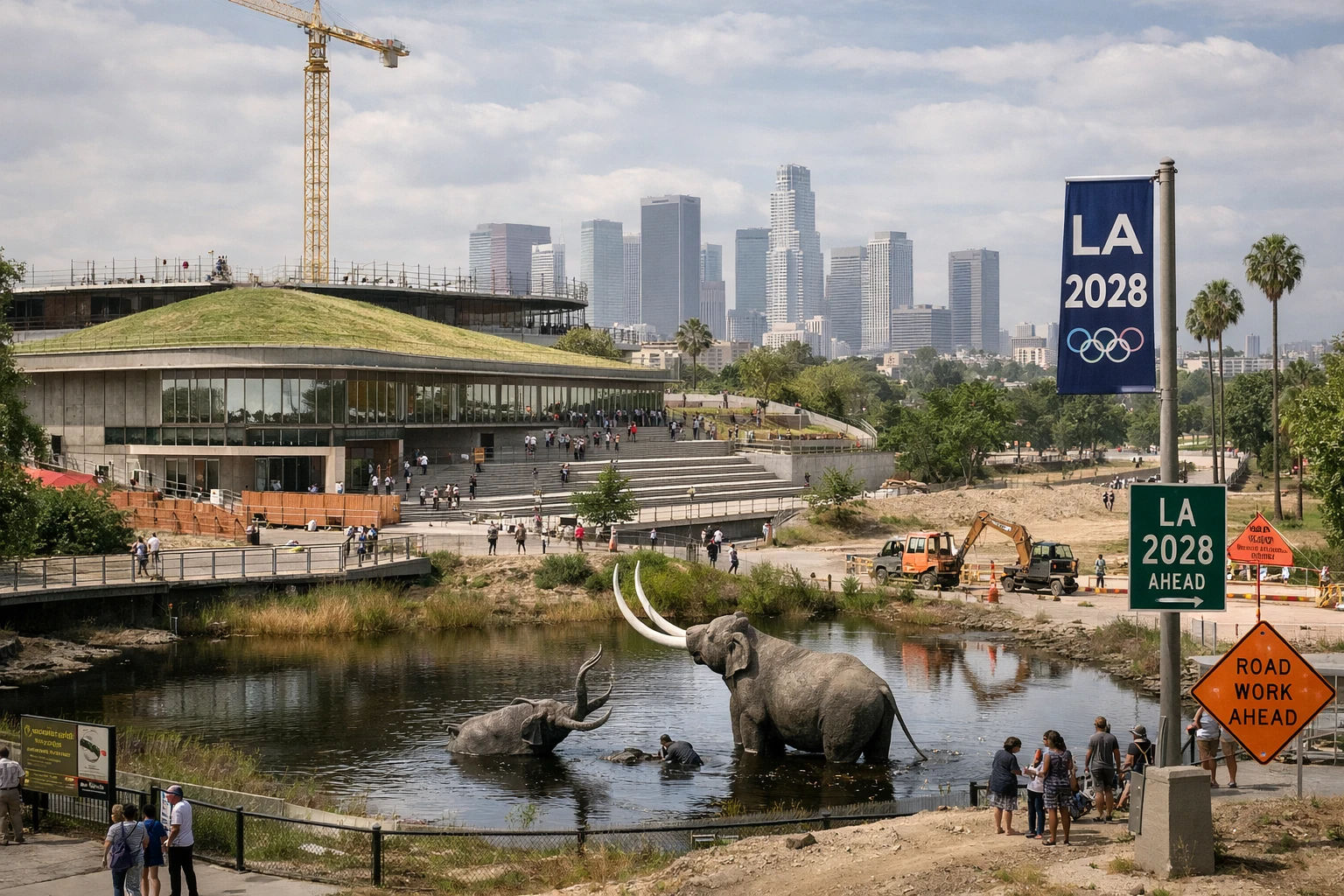
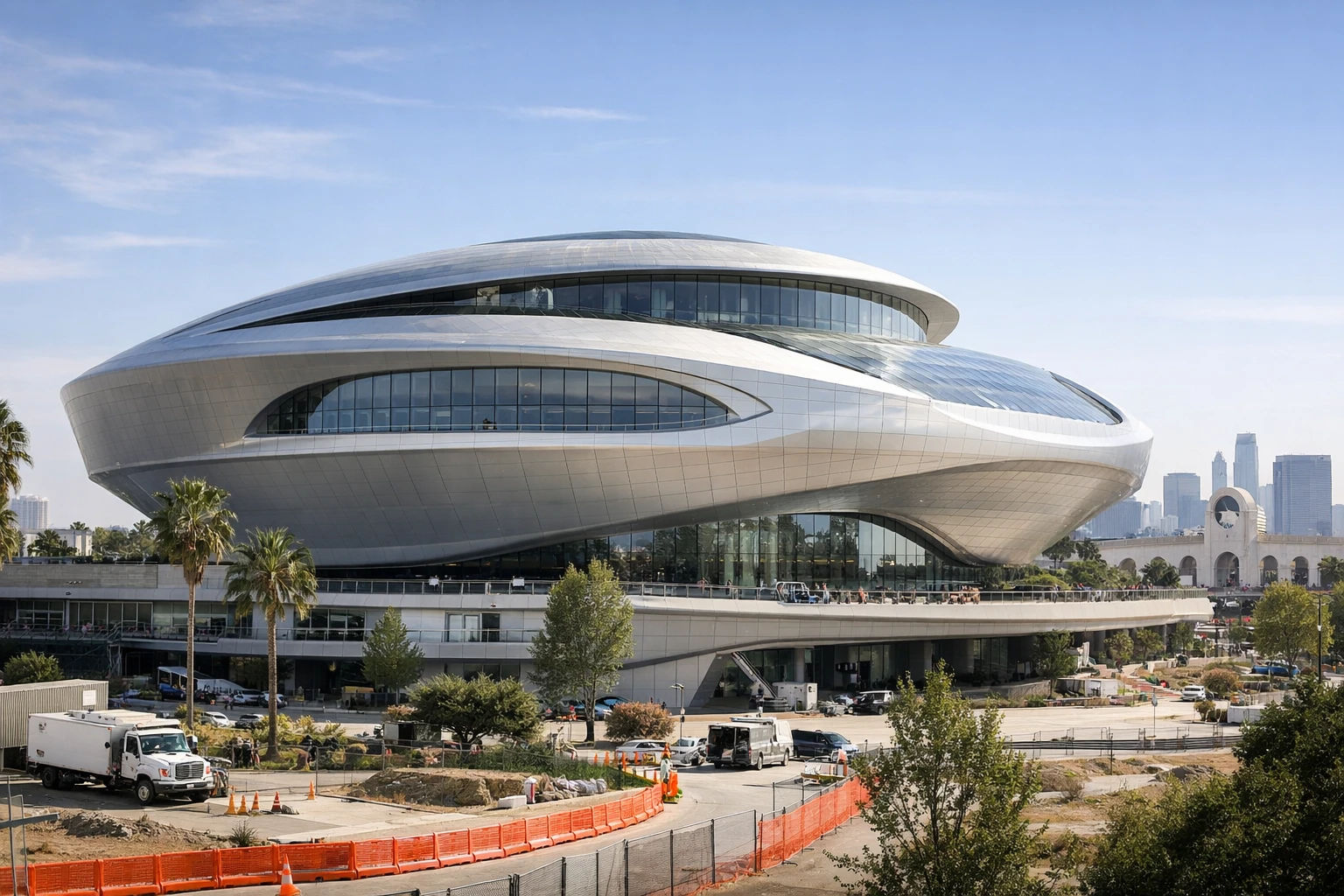
Stunning New Photos of the Lucas Museum
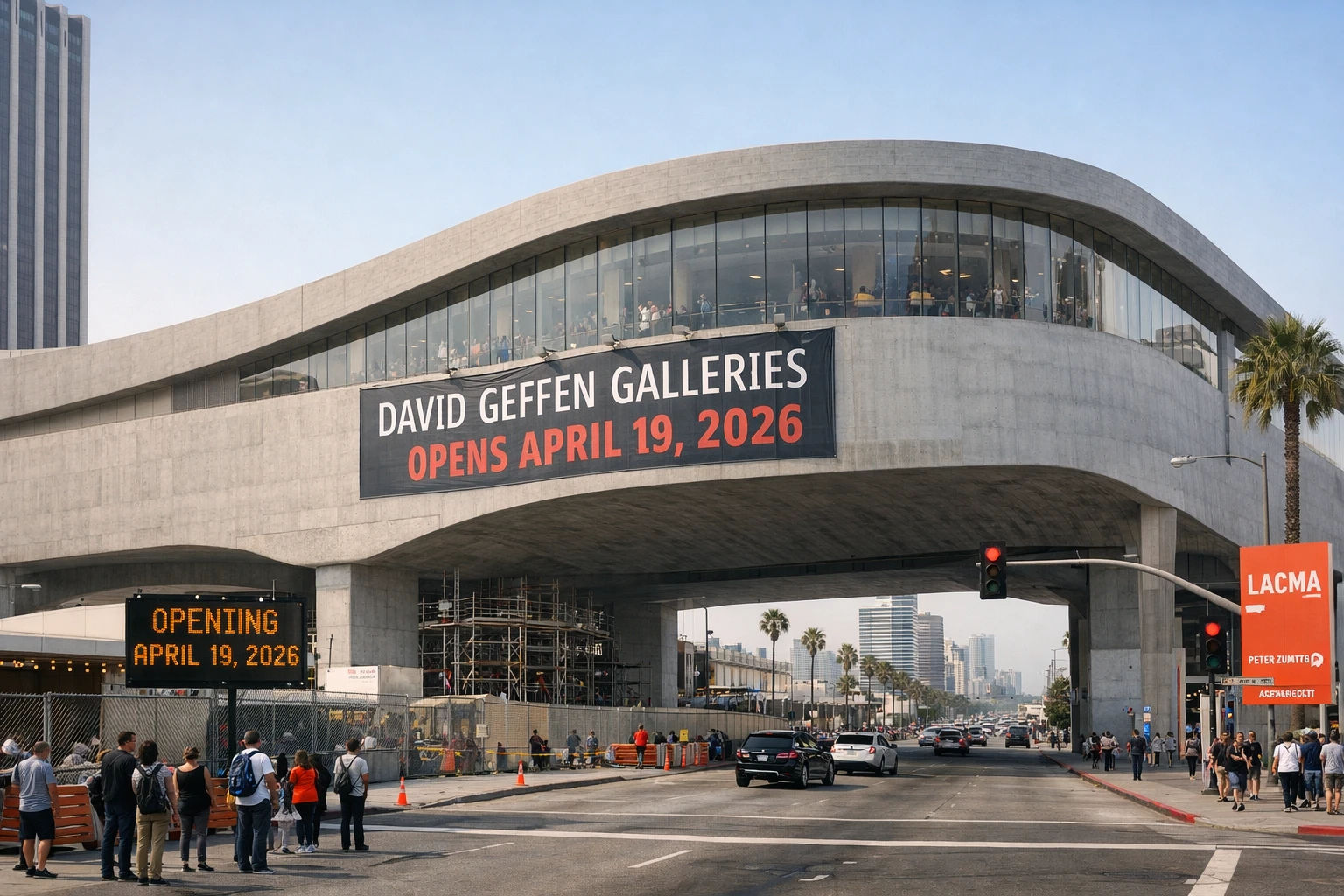
The images circulating this week are genuinely arresting. Construction photography from Exposition Park shows the Lucas Museum of Narrative Art in near-complete form: a vast, curving cloud of fiberglass-reinforced polymer panels hovering above a park landscape that was, not long ago, a sea of asphalt parking lots. The form is unlike anything else rising from a Los Angeles skyline that includes the Disney Concert Hall, the Getty Center, and the still-fresh David Geffen Galleries at LACMA. Six months from now, on September 22, 2026, it opens.
The Lucas Museum of Narrative Art has announced that it will open to the public on September 22, 2026, adding a new cultural institution to Los Angeles's Exposition Park. Founded by George Lucas and Mellody Hobson, the museum is dedicated to illustrated and narrative storytelling, understood as visual works that communicate stories across media and periods.
Construction broke ground on the Lucas Museum in 2018, and the $1 billion venue was supposed to open in 2021. But COVID-19 threw a wrench in those plans. The Lucas Museum then said it would open in 2023, but supply chain problems stemming from the pandemic got in the way. The opening was pushed back a third time, to 2025. Now, Lucas Museum officials are confident the highly anticipated building will open this upcoming September.
After eight years of construction, multiple delays, and one of the more complicated site selection stories in the history of American museum building, the building is finally visible from the 110 Freeway in something approaching its finished form. And what is visible is genuinely extraordinary.
MAD's Architectural Marvel
The building is designed by Ma Yansong of MAD Architects, the Beijing-founded firm with offices in Los Angeles and Rome. MAD's practice is built around a philosophy the studio calls "shanshui city," a vision of urban architecture that seeks to reintegrate the emotional qualities of natural landscapes into the built environment. The Lucas Museum is the largest and most visible expression of that philosophy anywhere in the United States.
MAD's architectural language is unambiguously sculptural. The studio conceived a biomorphic structure with fluid, continuous surfaces that evoke a natural organism resting within the park. The building is lifted off the ground by central arched steel beams spanning 185 feet, creating a covered public plaza, a floating canopy, that physically separates the built mass from street level. The result is an accessible urban threshold, sheltered from the elements, designed to encourage spontaneous gathering. At the center of the plaza, a central elliptical Oculus opens four stories upward toward the sky, establishing a vertical visual connection between interior and exterior. Three cylindrical glass elevators, visible from the north lobby, carry visitors up to the fourth-floor galleries, making the spatial journey fully perceptible.
The rounded structure has been clad with fiberglass-reinforced polymer panels, giving the building a slick, almost spaceship-like appearance, which the museum has described as both an "organic sculptural form" and "dream-like."
The exterior envelope is one of the project's most technically ambitious elements. The facade is clad in over 1,500 panels of fiberglass-reinforced polymer, each uniquely shaped, averaging approximately 8 by 32 feet. Every panel was fabricated through a process combining cutting-edge digital technology and robotics with handcrafting, ensuring chromatic consistency and surface quality across the entire curved volume. The joint lines between panels vary in width and orientation, strategically designed to complement the building's organic geometry without interrupting it. A ribbon of glass fiber reinforced concrete flows along the edges of the park, completing the exterior composition.
The scale of that fabrication achievement is worth pausing on. Over 1,500 individually shaped panels, each produced through a combination of digital precision and human craft, assembled into a continuous curved form that reads from above as something between a cloud and a living organism. The construction photography released this week shows the completed cladding system in full, and the consistency of the surface across the building's entire profile is the most striking thing visible in the images.
"MAD's design serves as a metaphor for storytelling and imagination, and is a tribute to Los Angeles' pioneering spirit and the diversity of its inhabitants."
Transforming the Campus
The building is significant. The campus transformation surrounding it may be equally so for the South Los Angeles community that lives within walking distance of Exposition Park.
Surrounding the museum, landscape architect Mia Lehrer is transforming what was once a sea of parking lots into a shaded public oasis, planting over 200 trees and creating a green, walkable environment. This shift from car-dominant infrastructure to community-oriented parkland aligns with the museum's broader mission to be a place for people, not just artifacts.
Located on an 11-acre site formerly used as surface parking, the project comprises a 300,000-square-foot structure and new public green spaces. To put that in physical terms: 11 acres of what was previously hot asphalt in one of the densest urban neighborhoods in California is being converted into shaded, planted, publicly accessible parkland. The trees alone represent a generational investment. Over 200 new trees in South Los Angeles, many of them large-canopy species that will provide meaningful shade within a decade, is the kind of environmental and community infrastructure that the neighborhood around Exposition Park has long needed.
Studio-MLA's landscape design wraps the park around and above the building, with planted surfaces extending onto the museum's roof and creating a green horizon line when viewed from the surrounding streets and from the Memorial Coliseum next door. The rooftop garden is a functional extension of the park rather than an aesthetic flourish, and the event space beneath the building's ribbed cloud ceiling connects interior and exterior programming in ways that few institutions attempt.
The north lobby faces the California Science Center and the Natural History Museum, two of the most visited cultural institutions in the Los Angeles region, creating a natural civic campus that now includes five major cultural institutions within a short walk of each other. The combination of the Lucas Museum, the California Science Center, the Natural History Museum, the California African American Museum, and the new Coliseum renovations makes Exposition Park one of the most significant cultural districts in the American West.
Inside the Museum: A Radical Curatorial Vision
The building's physical ambition is matched by a curatorial premise that is genuinely unlike what any other major American museum has attempted.
The 100,000-square-foot museum will contain more than 40,000 artworks spread throughout 35 galleries. Visitors will enjoy paintings by Norman Rockwell, Beatrix Potter, Frida Kahlo, and others. There will be comic art by Winsor McCay, Jack Kirby, Frank Frazetta, Alison Bechdel, Chris Ware, and R. Crumb, and photographs by Gordon Parks, Henri Cartier-Bresson, and Dorothea Lange.
The implicit argument of that collection, placing Norman Rockwell alongside Frida Kahlo alongside Jack Kirby alongside Dorothea Lange, is that narrative art does not observe the hierarchies that the traditional museum system enforces. Fine art painting is not inherently more significant than illustration. Photography is not less than painting. Comic art is not less than any of them. What matters is whether the work tells a story and how powerfully it does so.
The Lucas Museum will house works by artists such as Judy Baca, N.C. Wyeth, Carrie Mae Weems, Diego Rivera, Frank Frazetta, Ralph McQuarrie, Jacob Lawrence, Kadir Nelson, Paul Cadmus, Yinka Shonibare, and Jack Kirby.
The presence of Ralph McQuarrie in that list is the most obvious indicator of George Lucas's personal investment in the curatorial vision. McQuarrie was the concept artist who designed the visual universe of Star Wars, creating the original images of Darth Vader, R2-D2, C-3PO, and the Millennium Falcon that became the basis for the most commercially successful film franchise in history. His work sits alongside Diego Rivera and Carrie Mae Weems not as a celebrity curiosity but as a sincere argument that the visual imagination of popular storytelling belongs in the same critical conversation as canonical fine art.
In 2021, the museum announced the acquisition of the archive of materials related to the development and execution of Judy Baca's half-mile-long mural The History of California, popularly known as the Great Wall of Los Angeles, located in the San Fernando Valley. The Great Wall of Los Angeles is one of the most significant works of public art in California, and its presence in the Lucas Museum's collection connects the institution directly to the communities of South Los Angeles and the San Fernando Valley in a way that institutional prestige collections rarely achieve.
The galleries are named after themes drawn from the human experience: love, family, community, childhood, adventure, reflecting the museum's inclusive, narrative-driven identity. That naming choice is itself a curatorial statement. Most museums name their galleries after donors, geographic regions, or art historical periods. The Lucas Museum names them after human experiences, which is the frame through which the curatorial team wants you to encounter art.
Avenue of Amenities
Beyond galleries spanning 9,290 square meters, the museum will house two state-of-the-art theaters, ten education studios, a library, a restaurant, a museum shop, and even a rooftop event space beneath its ribbed cloud ceiling.
The two theaters are designed for film screening and live performance, which makes sense for an institution founded by one of the most important directors in cinema history. The programming potential of a museum dedicated to narrative art, with two dedicated theaters and a collection that includes concept art, storyboards, and production design materials from major films, is genuinely exciting. A George Lucas-founded institution in Los Angeles with dedicated screening facilities could become one of the more significant film programming venues in the city.
The building features a library, dedicated learning studios, two theaters, a restaurant, a café, and an event space. The distinction between restaurant and café is worth noting for visitors planning a day at Exposition Park. A restaurant implies a full-service meal destination with a thoughtfully designed menu and the intention to draw visitors who come specifically to eat. A café implies the faster, lighter option for people mid-museum who need a coffee and something small. Both will likely be designed to an elevated standard given the institution's ambitions and the Lucas family's approach to every other aspect of the project.
The rooftop event space, accessible to special events and presumably to the public at some times, offers views across Exposition Park to the Memorial Coliseum, BMO Stadium, and the downtown skyline to the north. That vantage point, from the green roof of a curved cloud-shaped museum, looking north toward the downtown skyline with the Olympic venues in the foreground, will be one of the more distinctive views available to visitors of any Los Angeles cultural institution.
Significance for South Los Angeles
Exposition Park's location in South Los Angeles is not incidental to the Lucas Museum's significance. It is central to what the museum is trying to be.
George Lucas announced on January 10, 2017, that the museum would be built in Exposition Park in Los Angeles, citing the proximity of University of Southern California, his alma mater, the Los Angeles Memorial Coliseum, BMO Stadium, other museums, and local schools in the South Los Angeles region.
The decision to build in Exposition Park, after the Chicago lakefront site fell through, reflected a genuine commitment to a specific community rather than the default institutional preference for a wealthier neighborhood with established cultural audiences. Exposition Park is surrounded by residential neighborhoods where median household incomes are significantly below the city average, where public transit connectivity is strong, and where proximity to world-class cultural institutions has historically not meant that those institutions were actually designed for the people who live nearest to them.
"This is a museum of the people's art, the images are illustrations of beliefs we live with every day. For that reason, this art belongs to everyone," Hobson shared in a statement.
The collection's breadth, which includes muralism alongside fine art, comic art alongside photography, science fiction imagery alongside canonical illustration, reflects a deliberate effort to build a museum whose content is genuinely accessible to people who did not grow up going to art museums. The Great Wall of Los Angeles archive alone is a profound act of recognition for the Chicano and Latino communities of South LA and the San Fernando Valley who participated in its creation and whose history it documents.
The 200-tree landscape installation is not just environmentally significant. It is a public health investment in a neighborhood where tree canopy coverage has historically been among the lowest in Los Angeles County, where heat island effects are more severe, and where access to shaded outdoor space is meaningful in concrete quality-of-life terms. Mia Lehrer's campus transformation at the Lucas Museum is, among other things, a gift of shade to a neighborhood that needed it.
The Journey to Opening Day
The opening of the Lucas Museum on September 22 will feel, for anyone who has followed its construction, like the completion of a very long sentence that started in 2018. The museum was originally set to open in 2021, but the opening was pushed to 2023 due to delays associated with the COVID-19 pandemic. In 2022, the opening was pushed again, to 2025. In 2025, it was pushed back further to 2026.
Before Los Angeles, the museum had an entirely separate existence as a planned Chicago lakefront institution that spent years in a contentious public debate before George Lucas ultimately chose Los Angeles instead. That Chicago chapter, which stretched from 2014 to 2017 and involved Friends of the Parks litigation, competing mayoral offers, and significant public controversy, was followed immediately by the Los Angeles announcement and the 2018 groundbreaking.
"Stories are mythology, and when illustrated, they help humans understand the mysteries of life," Lucas shared after the September 22 opening date was announced.
That statement, which reads as both personal and institutional, captures the animating idea behind the entire project. George Lucas built his career on the power of visual narrative to connect people to archetypal stories. The Star Wars saga, whatever one thinks of its later iterations, functioned for its first generation of viewers as mythology in the precise sense Lucas describes: a set of images and stories that organized their emotional understanding of heroism, sacrifice, community, and evil. The museum he has built is an argument that this kind of storytelling, at every level of prestige and in every medium, is worth taking seriously as art.
Plan Your Visit
The Lucas Museum at Exposition Park is located at 3900 W. Martin Luther King Jr. Blvd, Los Angeles, CA 90007, adjacent to the Natural History Museum and the California Science Center.
By Metro: The E Line stops at the Expo/Vermont station, which is a short walk from the museum. The Metro connection makes Exposition Park genuinely accessible from Santa Monica, Culver City, Downtown, and the Eastside without a car. For opening weekend specifically, Metro is the strongly recommended transportation choice.
By car: Parking at Exposition Park is available in the structures along Exposition Boulevard and around the Coliseum. Opening weekend will draw significant crowds across the entire campus, so plan to arrive well before your intended museum entry time.
Tickets: The museum has not yet released full ticketing information or pricing as of this writing. The Lucas Museum website at lucasmuseum.org is the primary resource for updates, and signing up for their email list puts you first in line when reservation windows open. Given the global attention this opening is receiving, selling out on early dates is a realistic possibility.
The Exposition Park campus: Plan to spend at least half a day rather than just a museum visit. The Natural History Museum of Los Angeles County, the California Science Center with the Space Shuttle Endeavour, and the California African American Museum are all within a 10-minute walk. The new Lucas Museum campus itself, with its 11 acres of parkland, two restaurants, and rooftop garden, rewards a longer visit than any individual gallery can accommodate.
Follow the Story
September 22 is 26 weeks away. In the Los Angeles cultural calendar, the spring and summer between now and opening day will produce a steady stream of Lucas Museum news: collection previews, programming announcements, the first public events in the outdoor campus spaces, and presumably the kinds of high-profile special previews that a George Lucas opening in Los Angeles will attract.
The five-story museum is surrounded by parks, which also extends up onto the roof, injecting much-needed greenery into the area.
The architecture alone makes this one of the most significant openings in the history of Los Angeles cultural infrastructure. The collection and the curatorial philosophy make it potentially the most intellectually surprising new institution to open in the city in a generation. And the neighborhood, South Los Angeles, Exposition Park, the streets around the Coliseum where the 1984 and 2028 Olympic Games were and will be held